
China Between Deflation and the Future
- Simon Kiwek

- 5. Dez. 2024
- 9 Min. Lesezeit
Aktualisiert: 12. Jan.
While the rest of the world grapples with rapidly rising prices, China faces concerns over deflation, a bubble in the real estate market, and a downturn in industrial production. Contagion effects could once again shake the global economy.

The collapse of the two Chinese real estate giants, Evergrande and Country Garden, has evoked memories of the Global Financial Crisis of 2008. Like then, the crisis originated in the real estate sector, with Evergrande alone holding financial liabilities amounting to $300 billion. By 2023, the total liabilities of Chinese property developers had risen to approximately 80% of their total assets.
These debts are not solely comprised of outstanding loans to banks but also include obligations to construction firms and suppliers. Particularly uncertain is the fate of millions of unfinished yet prepaid housing units. The vacant properties in China could house nearly the entire population of France. Following the bankruptcies of Evergrande and Country Garden, many of these properties have been transferred to state-owned enterprises, as well as to the central government in Beijing and provincial administrations. In response, authorities have taken decisive action, even demolishing entire ghost towns.
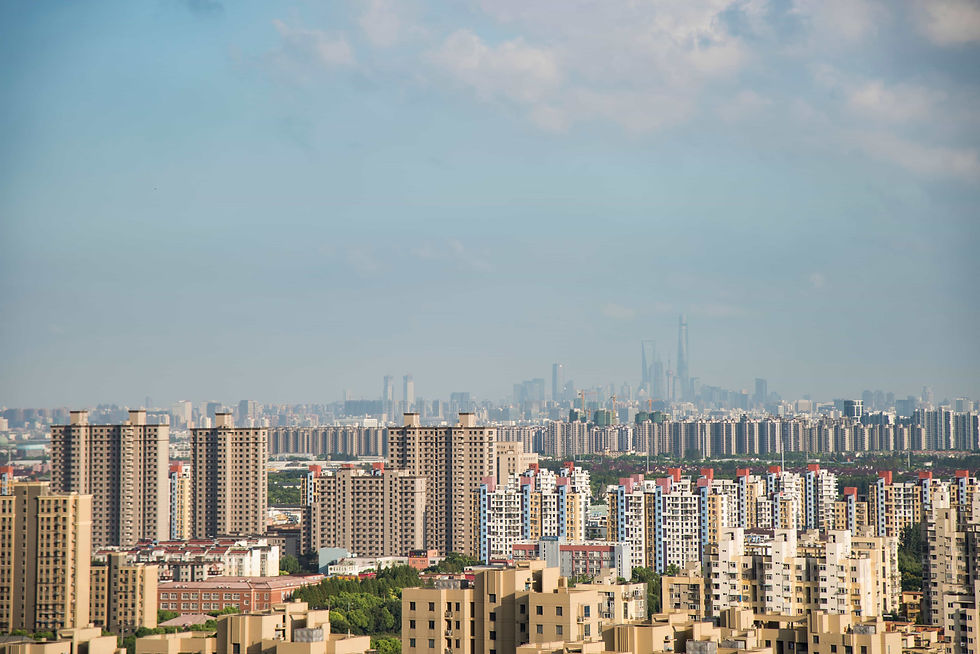
Massive Chinese ghost cities, large enough to house the entire population of France, are causing unrest in global financial markets. Fears have arisen of a financial crisis similar to 2008, when the U.S. real estate market collapsed. Pictured: Shanghai Residential Buildings, 2018. For now, the situation appears stable, according to the IMF (Source: Barnaby Chambers / Shutterstock, 2014).
Furthermore, Beijing facilitated access to credit, relaxed mortgage regulations for first-time buyers, and issued new bonds to finance infrastructure projects. State-owned banks also contributed with financial injections. Authorities successfully managed to prevent contagion effects from spreading to the broader financial markets. Even the International Monetary Fund, the custodian of global financial stability, currently views the situation as under control.
A financial crisis akin to 2008, with all its repercussions, is not on the horizon. However, China remains trapped in a spiral of falling prices. The shadow of deflation looms over its development. While similar periods have occurred repeatedly since the turn of the millennium, the current phase, which began in 2020, is the longest to date. Without comprehensive reforms, China risks facing a "lost decade," similar to Japan’s experience.
The Absolute Power of the Communist Party Begins to Falter
For decades, the Communist Party of China has anchored its unchallenged authority on a central promise: the steady growth of prosperity, from which everyone can benefit. However, this foundation now appears to be cracking. This promise of prosperity enabled many citizens over the past 20 years to arduously lift themselves out of poverty and into the middle class, investing much of their savings in real estate, or "concrete gold." Yet, as property prices fall, these savings are steadily losing value — along with the trust of Chinese citizens in their government.
Was their years of hard labor in factories under difficult conditions in vain? The crisis is also stifling the development of other sectors, preventing an economic recovery in China similar to that seen in other parts of the world following the end of COVID lockdowns. While semiconductor production, green industries, and the manufacture of advanced capital goods thrive thanks to substantial government subsidies, internet platforms, education, and the entertainment industry have been subjected to strict regulations.
Most of these trends predate the pandemic. The credit boom had already come to an end, and continuous downward price corrections in the real estate market were underway even before COVID struck. Both the bursting of the credit bubble and the pandemic triggered precautionary saving among the Chinese population, as people sought to protect themselves against further existential threats. These funds have now been withdrawn from the economy and are missing from consumer spending.
Meanwhile, regional governments in the provinces took on massive debts to sustain China's economic miracle. Local industries — from shoe factories to shipyards for container vessels — were built on a grand scale. Today, many of these factories stand idle, and the country is burdened with significant overcapacities across almost all sectors. The risk of deflation continues to rise.

Quelle: statista, 2024
Debt Situation of Chinese Companies
The crisis in the real estate sector is also impacting the rest of China's corporate landscape. Even outside the real estate sector, profitability is declining. Due to lower sales revenues caused by unsettled consumers, the corporate sector's profit margin dropped from 18.4 percent in 2017 to 16.3 percent in 2023. Meanwhile, corporate debt relative to China's GDP has become one of the highest in the world — and it continues to rise. Despite this elevated level, the debt situation outside the financial sector is largely considered stable. There are also indications that debt levels, particularly among state-funded enterprises, are improving.
The situation in the private sector is significantly more challenging. While private companies are generally more profitable than state-owned enterprises, the proportion of firms reporting substantial losses is also much higher. This has split the private sector into two distinct camps: on one side are highly profitable companies, while on the other are those operating deep in the red. This divide is particularly stark among small businesses.
While some small firms are financially robust, many others face significant difficulties in securing external financing. The latter often lack sufficient cash reserves to weather further debt crises, a situation that now affects two-thirds of all companies. The growing gap between small businesses is increasingly alarming. While some achieve impressive profits, many others are grappling with acute liquidity issues that could threaten their survival even in the face of minor shocks.
This dynamic also poses substantial risks for the banking sector. Under political pressure, banks have significantly expanded their lending to small businesses; however, 24 percent of these small enterprises reported losses in 2023. This situation evokes memories of the 2008 Global Financial Crisis, when the integrity of the entire banking system in the U.S. was called into question due to the inclusion of numerous bad loans.
China's Service Sector Needs Innovation
As the boom in the oversized real estate and manufacturing sectors wanes, Beijing's focus is shifting toward services. Industries such as hospitality, transportation, communication, as well as financial and business services, have already gained significance in the past, while agriculture has consistently declined. Alongside increasing prosperity, China has also experienced deindustrialization, similar to trends seen in Western industrialized nations.
Although Beijing has declared an intention to prioritize green technologies and high-tech manufacturing, the service sector remains largely untapped territory with immense potential. For comparison, in developed economies, the service sector contributes approximately 20 percent more to economic value-added than it does in China.
China's service sector is also divided into two main areas: market-based services and non-market services. The latter include public administration, healthcare, and education, which even show negative productivity growth. In contrast, market-based services—those that operate in competitive environments—are now achieving productivity growth comparable to that of the manufacturing sector. This structural shift toward a less state-dominated economy is thus becoming evident within the service sector as well.
Private enterprises remain the driving force behind this transformation. In contrast, state-owned enterprises continue to absorb a disproportionate share of resources—both labor and capital. Thanks to political connections, including ties to provincial administrations, and substantial government subsidies, their dominance persists despite often operating inefficiently. This dynamic obscures the real productivity gains achieved through innovation in the service sector. If market forces were given more room to operate, China could better harness the full potential of this sector.
However, state-owned enterprises act as a drag on progress. For the Chinese economy as a whole—especially the service sector—it is crucial to open up further to trade, reduce restrictive regulations, and limit the influence of state-owned firms. This issue is particularly acute in construction, where state-owned enterprises account for 34 percent of activity, and to a lesser extent in manufacturing, where their share is approximately 21 percent.
Employment among young Chinese reveals a structural shift. They are predominantly employed in IT, culture and entertainment, as well as education, healthcare, and business services. At the same time, employment in agriculture, construction, transportation, and other labor-intensive industries is declining. Only in goods production do they slightly exceed the average of previous generations. However, even here, the focus is increasingly on green tech and high-tech goods, while less profitable and environmentally harmful activities are shifting abroad. (Source: IMF, 2024)
Labor Mobility for All
The service sector is particularly labor-intensive, but in China, workforce mobility is significantly restricted by the Hukou system. This household registration system, introduced in the 1950s, classifies the population into urban and rural residents. Initially, the system was designed to prevent migration from impoverished rural areas to the cities and to maintain the labor force in agriculture. However, it also created profound inequalities in access to public services such as education, healthcare, housing, and other social benefits.
With the rapid growth of industrial cities along China’s coast, the Hukou system came under increasing strain. It has effectively created a massive population of 290 million migrant workers who shuttle between rural areas and urban centers. These workers make a critical contribution to the economy but have little to no access to public services in the cities where they work.
Private, often informal schools have frequently emerged to partially fill gaps in the public education system for migrant workers' children. At the same time, many children of migrant workers are sent back to their home regions as "left-behind children" to attend public schools there. Health issues present additional challenges for migrant workers. Lacking access to formal hospitals, they often must pay for their treatment out of pocket, frequently relying on unregulated facilities.
Employers often attempt to fill some of these gaps by providing dormitories or rudimentary medical support. Digital applications like Alipay have also improved access to financial services. In major cities like Shanghai and Beijing, a points system has been introduced. This system evaluates criteria such as education, employment, and length of stay, allowing qualified migrants to acquire an urban Hukou.

Shanghai Hongqiao Railway Station. During the Chunyun period, the Chinese Spring Festival, up to 90 million residents, who live as migrant workers in major cities, travel back to their rural hometowns. They lack legal residency status in the cities and are excluded from many social benefits. (Source: Robert Way / Shutterstock, 2024)
The economic downturn is increasing pressure on authorities to relax the rigid Hukou system. Greater labor mobility would allow workers to move to areas with more lucrative job opportunities. This would benefit not only the workers themselves but also young, innovative companies that are currently constrained in their growth due to labor shortages — ultimately boosting the overall economy as well.
China's Investment Activity with Foreign Partners
Since the global financial crisis of 2008, net foreign direct investment (FDI) into China has shown a persistent downward trend. Compared to other emerging markets and developed Asian countries, foreign direct investments in China have been disproportionately focused on the manufacturing of goods and the production of strategic assets. However, these investments have sharply declined — by an average of 81% compared to the years 2015 to 2019 — due to the trade war with the United States and geopolitical tensions surrounding Taiwan. This decline is largely driven by the withdrawal of investments from the U.S. and other Asian industrialized nations.
The reasons for falling investments, however, are not solely external. Uncertainty about China's economic growth significantly contributes to the trend. Additionally, the Communist Party's economic policies have created an environment that unsettles investors. Concerns about property rights security and a lack of trust in stable regulatory frameworks are deterring potential investors.
In contrast to the declining inflow of foreign investments, China’s outbound investment flows remain stable. However, this stability masks a geographical shift favoring countries more geopolitically aligned with China, while the share of investments in wealthier industrialized nations declines. Since Russia’s invasion of Ukraine, geopolitical bloc formation has intensified: on one side, the U.S. and Europe; on the other, Russia and China. Within this context, Chinese companies are diversifying their risks to better prepare for the unpredictable geopolitical environment and the increasingly confrontational relationship with the U.S.
Trade and investment ties between China and the U.S. are being increasingly dismantled, widening the gap between the two nations. Under these conditions, a new group of states has emerged: so-called "connector" countries, which aim to remain neutral in the geopolitical divide. These nations position themselves as bridges, enabling international trade and investment flows to continue relatively unhindered despite global tensions. Leading this group are Vietnam and Mexico. Between 2018 and 2022, Vietnam saw a 170% increase in direct investments, while Mexico achieved an impressive 300% growth. In this role, these countries bolster the stability and resilience of the global economy.
Rumors of China's Collapse Are Greatly Exaggerated
There is no doubt that China is at a critical juncture in its rapid development process. A "Korean" or "Japanese" scenario looms, where a textbook economic ascent was abruptly halted by a financial and credit crisis. However, China's starting position is markedly different: the country is increasingly developing its own key technologies instead of merely copying, and in many areas, it has already surpassed the West. Examples include advancements in electric mobility and applications of artificial intelligence.
The Chinese government is also investing heavily in overcoming the current crisis. Initiatives include a $178 million scrappage program that promotes the replacement of old combustion vehicles with electric cars, eased credit conditions, efforts to stabilize the real estate market, and the promotion of new business models in e-commerce—from e-sports to unmanned retail stores.
The International Monetary Fund currently assesses China's economic situation as stable. Nevertheless, significant challenges remain. These are not only external, driven by geopolitical tensions, but also internal, requiring the removal of barriers to rekindle economic growth. Regaining the trust of both domestic and foreign investors is especially critical, as they increasingly feel threatened by legal uncertainties and fear for the safety of their assets.
Resolving the crisis in the real estate market is essential, as the risk of contagion to other sectors of both the Chinese and global economy persists. If Beijing succeeds in controlling these problems, consumer confidence could return. Currently, many households prefer to save for unforeseen emergencies rather than channel their funds into consumption. At the same time, subsidies that contribute to supply-side overcapacities—such as excess factories—should urgently be scaled back. Only in this way can the risk of further deflation be mitigated.
