
From the Caucasus to Central Asia: Why Millions Migrate to Russia
- Simon Kiwek

- 18. Apr. 2025
- 5 Min. Lesezeit
Aktualisiert: 9. Jan.
Despite global isolation, Russia remains a magnet for millions of labor migrants—shaping the economy and society across Eurasia. But these dependencies are beginning to loosen.
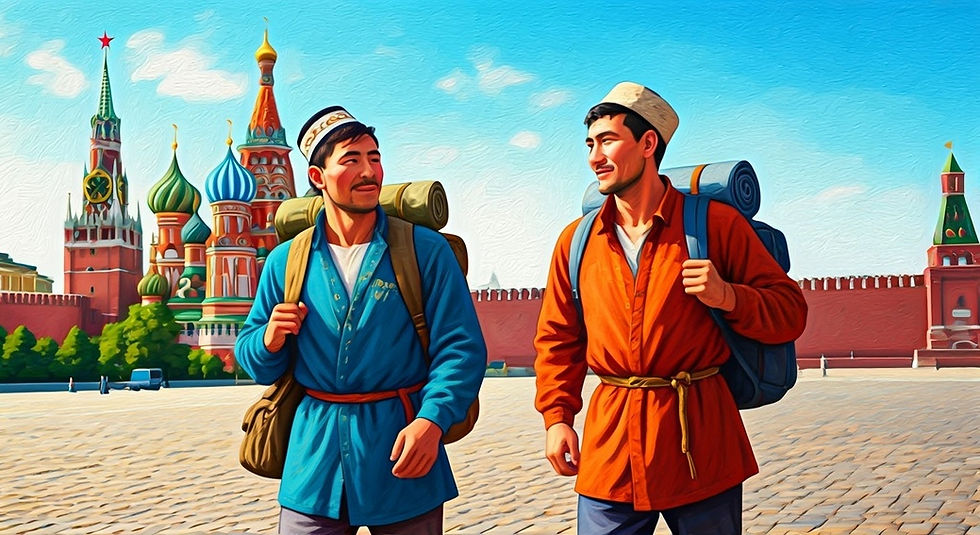
Despite international isolation following the invasion of Ukraine, Russia remains one of the most important destinations for labor migrants worldwide. Even 35 years after the collapse of the Soviet Union, the country continues to attract people from the Caucasus, Central Asia, and former Eastern European Soviet republics. The destinies of these countries have been closely intertwined for centuries. Russia still acts as a protector, investor, and cultural hegemon.
Remittances from labor migrants in Russia are vital for many people in countries such as Uzbekistan, Armenia, or Tajikistan. However, the world is changing there as well, and the search for new migration routes has begun.
Russia: A magnet for millions of migrants
Russia ranks fourth globally—after the United States, Germany, and Saudi Arabia—as a destination for international migration. In 2023, an estimated 10.5 million migrants were living in Russia. However, the actual number is likely much higher, as many people enter the country without official papers or registration. The long, hard-to-control borders further facilitate migration.
Take Tajikistan as an example: in 2023, around 1.3 million Tajiks were officially living in Russia. In the past two years, another 200,000 received Russian citizenship. At least 630,000 people came from Uzbekistan. However, estimates suggest there could be as many as 4 to 8 million Uzbeks in Russia when including those living in the country illegally. There are also around 328,000 Kyrgyz migrants. Moldova, which is linguistically connected to Romania and Italy, had around 300,000 migrants in Russia by 2020—one-fifth of all Moldovan emigrants.[1]
The vast, largely unsecured borders of Central Asia facilitate migration to Russia.

(Source: Alexander Lukatskiy/shutterstock)
From Soviet Internal Market to Migration Magnet
Even during Soviet times, many people from Central Asia and the Caucasus worked in Russian industrial centers. After the collapse of the Soviet Union, Russia remained one of the few republics with significant industrial production and higher wages.
Russia’s role as a destination for migrants is therefore historically rooted. The shared language and absence of visa requirements still facilitate migration today. The route to Russia is particularly attractive for seasonal and low-skilled laborers.
Remittances as a Lifeline for Countries of Origin
Labor migrants send billions of dollars back to their home countries every year. These remittances are the most important external source of finance for many economies neighboring Russia—surpassing even foreign direct investment or development aid.
In the Central Asian republics, remittances from Russia often account for up to 80 percent of all foreign transfers. They contribute between 15 and 39 percent to the gross domestic product and are thus a crucial lever for consumption, investment, and poverty reduction.
Country | Remittances (Billion USD) | Share of GDP (%) | Share from Russia (%) |
Tajikistan | 3.6 | 39 | >80 |
Kyrgyzstan | 2.5 | 22 | 94 |
Uzbekistan | 13.9 | 15 | 78 |
Armenia | 1.45* | 6* | 69 |
Moldova | 2.01* | 12.2* | |
Georgia | 4.2* | 13.3* | 37 |
Azerbaidjan | 1.91* | 2.6* | 63 |
Source: (Flore, 2018), (Worldbank, 2025)
Central Asia and the South Caucasus: A Mini Soviet Union
The countries of Central Asia are particularly dependent on migration to Russia. Wage disparities are significant: even after the ruble devaluation in 2022, the average income in Uzbekistan was only 42 percent of the Russian level, and in Tajikistan just 20 percent. Most migrants work in construction, agriculture, services, and transport—often without formal contracts or social protection.
Many people also migrate to Russia from Georgia, Armenia, and Azerbaijan. In Armenia and Azerbaijan, remittances are a key economic factor, especially during times of crisis. However, a shift is becoming apparent: Georgia is increasingly aligning itself with the West, and Azerbaijan is looking toward Turkey. Armenia, long a loyal ally of Russia, is now seeking more support from its diaspora in France and the United States, as the Kremlin has proven increasingly unreliable.
Tajik Immigrants Clean Moscow’s Streets

(Source: Oleg Elkov/shutterstock, 2024)
Eastern Europe and Ukraine: New Paths and Challenges
Many Eastern European countries are seeking alternative migration routes. Moldovans take advantage of their linguistic ties with Romanians, Italians, and Spaniards. Belarusians see little need to emigrate for economic reasons.
The situation for Ukrainians is particularly complex: in 2015, around six million Ukrainians were living in Russia. Ukraine emerged from the post-Soviet transformation period in worse economic shape than Russia. The migration corridor of people born in Ukraine and living in Russia is the third largest in the world—after Mexicans in the U.S. and Syrians in Turkey—with four million people.
After the annexation of Crimea and the war in Donbas, many Eastern Ukrainians fled to Russia. According to the UN, about 1.3 million Ukrainian refugees currently live in Russia—more than in Germany.
Remittances to Ukraine
Ukraine has always had a history of emigration: an estimated 20 million Ukrainians and their descendants live scattered around the world today. With Russia’s large-scale invasion, this diaspora mobilized vast sums to support their homeland—whether through humanitarian aid, weapons, or expertise. Ukrainian communities around the globe formed networks to assist their compatriots back home. Digital services made this easier than ever before.
Nevertheless, direct remittances to family members declined sharply—or even reversed: many Ukrainians living abroad began hosting their relatives instead of sending money. At the same time, Ukrainian men who were not allowed to leave the country sent their wages or income to their families who had fled to the EU. Furthermore, the National Bank of Ukraine changed its reporting method: since 2023, refugees are no longer classified as non-residents, and their payments are no longer counted as remittances.

(Source: Worldbank, 2025)
War in Ukraine Has Consequences for All Migrants
The war has also had indirect effects on other labor migrants in Russia. In 2023, the ruble lost significant value against the US dollar. Each ruble transferred lost nearly 40 percent of its purchasing power abroad. This led to increased migration: 72 percent more Uzbeks came to Russia compared to the previous year.
Overall, remittances declined by ten percent. Western sanctions and financial restrictions are making money transfers more difficult. Many banks in migrants' home countries no longer accept transfers from Russia out of fear of secondary sanctions. As a result, an increasing share is being handled through informal channels, which raises both costs and risks. While remittances between CIS countries used to be among the cheapest, they are now among the most expensive.
The terrorist attack at Moscow’s Crocus Hall—carried out by suspected Tajik IS supporters—triggered a wave of crackdowns and deportations by Russian authorities. At the same time, skepticism among the Russian population toward immigration from Islamic countries is growing.

(Source: (Worldbank, 2025)
Will Russia Remain the Center of Labor Migration?
However, digitalization is opening up new opportunities for young people from Central Asia to find work in other countries. Governments themselves are beginning to recognize the risks of one-sided dependence on Russia. Uzbekistan is therefore actively seeking partnerships with countries like Germany and South Korea.
Meanwhile, Russia is suffering from a severe labor shortage—not just in agriculture, manufacturing, and the service sector, but even in the arms industry. Many take advantage of the authorities’ large bonuses to go fight in Ukraine—leaving gaps in the labor market. In addition, many well-educated Russians have emigrated to avoid being mobilized for war. The labor shortage is now estimated at nearly five million people.
Russia also benefits from remittances. In 2023, the country received 5.8 billion US dollars from abroad. Often, it is Chechen communities abroad sending money back to support their relatives in the impoverished North Caucasus republic.
The development of remittances acts as a seismograph for the region’s economic and political situation. Opportunities to earn money in Russia for one’s family back home are likely to continue declining in the coming years—unless one is willing to go to the front.
Young people from Central Asia are increasingly seeking other paths and destinations—and with that, building cultural ties to new host countries. Russia risks losing even more influence. But Russia, too, is reorienting itself: recruitment programs have been launched in Africa to bring young women to Russia.
