
Green Revolution Worldwide: In Charts
- Simon Kiwek

- 20. Jan. 2025
- 4 Min. Lesezeit
Aktualisiert: 12. Jan.
Renewable energy is booming globally. China leads the way, but is the pace enough for the green revolution?

Figure 1 Development of renewable energies in selected countries

The world is on the verge of a historic shift from fossil fuels to renewable energy. However, the journey is far from over, even as global momentum accelerates. China is frequently criticized as the world’s factory, pumping CO₂ into the atmosphere. Yet the Middle Kingdom is now accelerating its transition to renewables at an unprecedented pace. By 2023, China had installed 1.4 million megawatts of renewable energy—more than the European Union and the United States combined. The contributions of these other economic blocs pale in comparison, though they have also made progress.
Figure 2 Stable growth rates of renewable energies

Other countries are also achieving solid growth rates in renewable energy capacity. India and Brazil have expanded their renewables, albeit from a lower starting point. The European Union is following a stable growth path, while the United States, due to its political polarization over environmental issues, shows higher volatility. However, in periods of growth, it can even surpass the EU. Russia, on the other hand, lags behind. As a nation rich in oil and gas reserves, the shift holds little immediate economic appeal, and resources are further strained by the war in Ukraine. Globally, renewable energy capacity is growing at an average annual rate of 9.5%.
Figure 2 Stable growth rates of renewable energies

New hydropower plants remain primarily the domain of China and a few other emerging economies. The construction of such facilities is complex, costly, and time-consuming. However, when they go online, they result in significant leaps in the energy balance of smaller nations. In China, an infrastructure boom is driving hydropower expansion: rivers are being regulated, dammed, and diverted—not only for energy production but also to establish modern waterway transport networks and improve agricultural irrigation. In industrialized countries, most water resources are already utilized, leaving little room for further expansion.
Figure 4 Wind power capacities

Wind power remains a hallmark of industrialized nations, whether on land or in offshore parks along coasts. China dominates this sector as well, overshadowing all others, followed by the European Union. Depending on the location, a single wind turbine produces two to three megawatts. At full capacity, one turbine can supply 1,000 to 2,500 households, depending on a country’s per capita electricity consumption. Since President Joe Biden took office, the United States has made progress in wind energy but, like India, still lags behind.
Figure 5 Annual increase in solar energy capacity

The true growth champion, however, is solar energy. Once again, China faces criticism for its generous subsidies to the domestic solar industry. Yet it is precisely these affordable photovoltaic systems that are driving the global green transformation. With 600,000 megawatts of installed capacity, China shows a sharply rising trend. Europe has also significantly increased solar installations, spurred by skyrocketing gas prices following Russia’s invasion of Ukraine. In the United States and India, high energy prices have also encouraged a shift toward solar power, though to a lesser extent.
Figure 6 Development of global renewable energy capacities
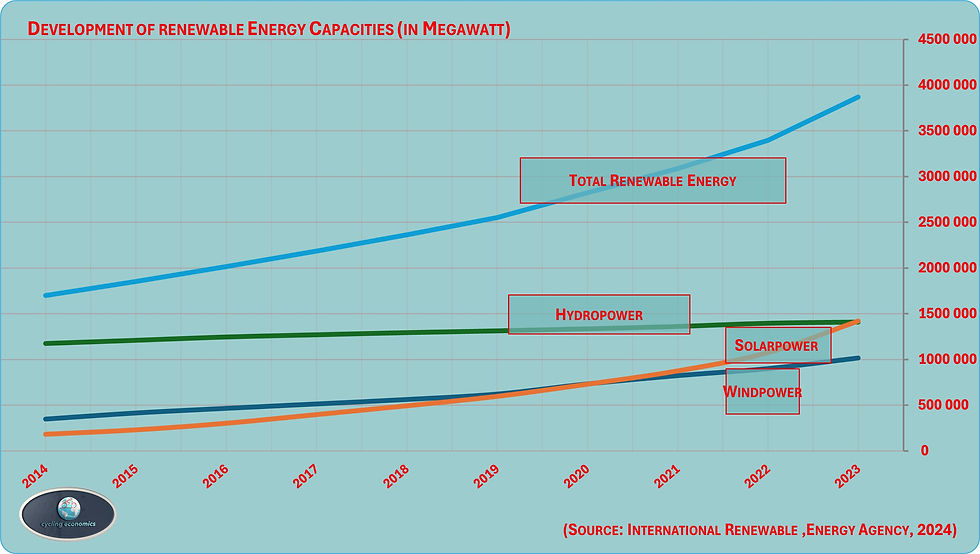
Solar energy is making its mark globally. Currently, 1.5 million megawatts are operational, and the technology has even caught up with hydropower, which has long been dominant. Hydropower, however, retains a crucial role in global energy production. Wind power is also contributing increasingly to the global energy mix. While the majority of these capacities are installed in wealthy industrialized nations and China, emerging economies are making strides to green their energy systems.
Figure 7 Solar-powered pumping systems in Syria

A look at off-grid statistics reveals the critical role of renewable energy in the development of poorer nations. While these account for only a small fraction of global capacity, they deliver tangible improvements in daily life. For example, the Syria Recovery Trust Fund supports numerous facilities that would otherwise be forced to shut down due to unstable power grids and diesel shortages for generators. This enables local authorities to maintain essential services such as hospitals and water supplies. In private households, off-grid systems are becoming indispensable. Affordable Chinese solar panels allow families to charge smartphones, power lights, and operate small appliances. They also drive solar-powered pumps for field irrigation and provide cooling systems for market stalls. In Africa alone, the number of autonomous solar installations has increased fivefold, symbolizing the growth of off-grid solutions such as small hydropower plants. (Source: Ammar-Alzeer/Shutterstock, 2020)
Figure 8 Share of renewables in electricity production

Yet, alongside the impressive expansion of renewable energy capacity, global energy demand continues to grow. Countless gas and coal power plants are still being built, threatening to negate the CO₂ savings achieved by renewables. A key indicator of progress remains the share of renewable energy in electricity production, though electricity accounts for only about a quarter of total energy consumption. In relative terms, the trend is encouraging: In the European Union, over 80% of electricity is now generated from renewable sources, although the stability of supply still needs improvement. China has also made significant progress, reaching a 50% share in 2023. Both India and the United States are showing upward trends but still lag behind the global average.
Overall, the green transformation is well underway worldwide. For citizens of emerging and developing countries, it offers the chance for greater independence from often unreliable centralized power grids. Many of these nations could eventually follow an alternative development path, starkly different from the fossil-fuel-intensive histories of industrialized countries. However, the speed and ambition of this transformation remain insufficient to meet self-imposed climate goals. Particularly in the global South, access to energy—the cornerstone of economic development—remains a central challenge.
