
Mice, Markets and Morality: Teachers on Four Paws
- Simon Kiwek

- 16. Apr. 2025
- 3 Min. Lesezeit
Aktualisiert: 12. Jan.
Millions of laboratory mice are indispensable for science. Yet, they, too, pay the price for progress.
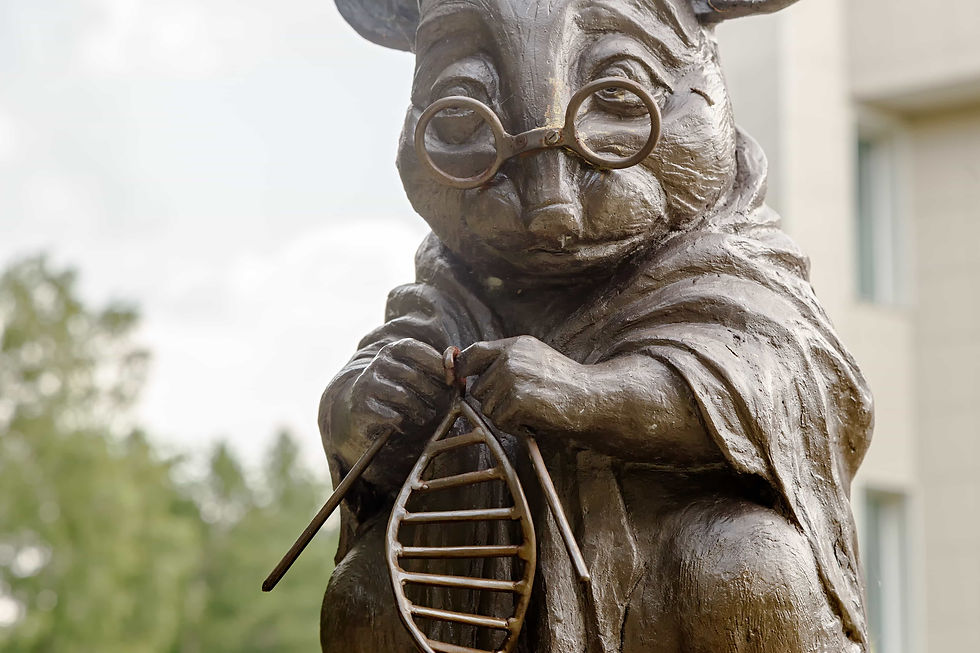
(Image Source: Collection Maykova/shutterstock, 2018)
In 2012, researchers in the Russian city of Novosibirsk unveiled a monument to mark the 55th anniversary of the founding of the Institute of Cytology and Genetics: a 70-centimeter-tall statue of a mouse in a lab coat and glasses, knitting a strand of DNA. This monument honors the sacrifice of all those laboratory mice that have facilitated human progress.
Small Animals, Big Impact
Mice have served as vital helpers in medical research for over 100 years. They closely resemble humans: about 98 percent of their genes match our own. Mice grow quickly, are easy to keep, and reproduce rapidly. As a result, they are ideal models for studying human biology. Researchers have bred hundreds of mouse strains specifically prone to diabetes, cancer, or Alzheimer’s disease. In this way, they help decode the mysteries of human health and disease.
Research on animals also leads to new therapies that help people stay healthy and productive for longer. This reduces costs for care and illness. Merely housing a laboratory mouse costs about 80 to 100 dollars per year. Even with these low investment costs, their economic benefits for humanity never have been calculated.
Russia Commemorates the Victims of Laboratory Mice

According to the monument’s creator, Andrey Kharkevich, the statue symbolizes the bond between a laboratory mouse and a scientist, both serving the same cause. (Image Source: Institute of Cytology & Genetics, n.d.)
Mice as the Key to Disease Research
One example: scientists discovered that the loss of certain nerve cells accelerates cognitive aging. They identified a gene that can slow this process. Such findings are especially valuable. More and more people are reaching an advanced age, and dementia is becoming increasingly prevalent.
Mouse Bunker in Berlin

Bleak, yet purposefully designed: the research facility for experimental medicine at the Free University of Berlin. Commonly known as the “Mouse Bunker,” researchers conducted animal experiments there until 2020. (Source: Mo Photography Berlin/shutterstock, 2021)
However, mice as laboratory subjects also reach their limits. Not everything can be translated to humans. In one study, 150 drugs that had proven effective against severe inflammation in animal trials failed in human applications. Many substances that save mice's lives ultimately fail in clinical trials.
Mice also play a role in training young scientists. Animals not suited for experiments are often used for practice purposes—such as learning surgical techniques. In this way, future researchers learn to handle life responsibly.
Ethical Decisions and the Principle of Hope
Lab mice don't just help test medications and cosmetics—a multi-billion-dollar market. They also offer insights into our own human nature. In one experiment, participants were asked to choose between money or the life of a mouse. Nearly half opted for €10—and let the mouse die.
Experiments with mice and rats reveal even more about us. In the 1950s, psychologist Curt Richter demonstrated how powerful hope and expectation can be. He placed the animals in a water tank with no escape. After a few minutes, they gave up and drowned. But just before exhaustion, Richter rescued some of the animals, dried them off, and placed them back in the water. The results were astonishing: these rats swam for up to 60 hours—much longer than those who had never been saved. Mice helped us understand how hope can act as a catalyst, enabling humans to summon incredible strength. Those repeatedly denied hope gave up much more quickly.
Like Human Rats
American researcher John Calhoun created what became known as the “Mouse Utopia” in his lab, to study social dynamics. Eight mice were initially placed in perfect comfort: unlimited food, ideal temperatures, medical care, and regular cleaning. They multiplied uncontrollably—doubling in number every 55 days. Once the population density reached a certain point, the mice began to show self-destructive and deviant behaviors. Classes and social groups formed, and outsiders—mostly younger mice—were bullied and injured. The females stopped reproducing and became reclusive. The males no longer competed for mates and withdrew from all challenges.
Everyone is free to draw their own conclusions about today's societal developments.
Mice Utopia 1970

(Image Source: Okamoto/wikicommons, 1970)
A Delicate Balance for the Future
The sacrifice of laboratory mice has extended our lives, helped fight disease, and deepened our understanding of ourselves and society. But the more we recognize how similar they are to us, the greater the moral dilemma: how much animal suffering can we justify in the name of human progress? The statue in Russia reminds us of the responsibility that comes with scientific experimentation.
