
Nigeria’s Shadow of the Past
- Simon Kiwek

- 8. Feb. 2025
- 2 Min. Lesezeit
Aktualisiert: 9. Jan.
The port city of Badagry was once a central hub for the slave trade. Today, a museum on the Atlantic coast serves as a reminder of this history.

Badagry als Handelszentrum der Sklaverei
Badagry was one of several ports along the West African coast through which people were shipped as forced laborers to plantations in North and South America. European traders—particularly the Portuguese, British, Dutch, and French—established trading posts and exchanged goods such as guns, alcohol, and textiles for enslaved people, who were supplied by African intermediaries. Not infrequently, the traded goods were made from raw materials that enslaved individuals had to extract in the New World. In Badagry, people were held in camps before being taken to the ocean via the so-called "Point of No Return" route.
Source 1: A Monument at the "Point of No Return"
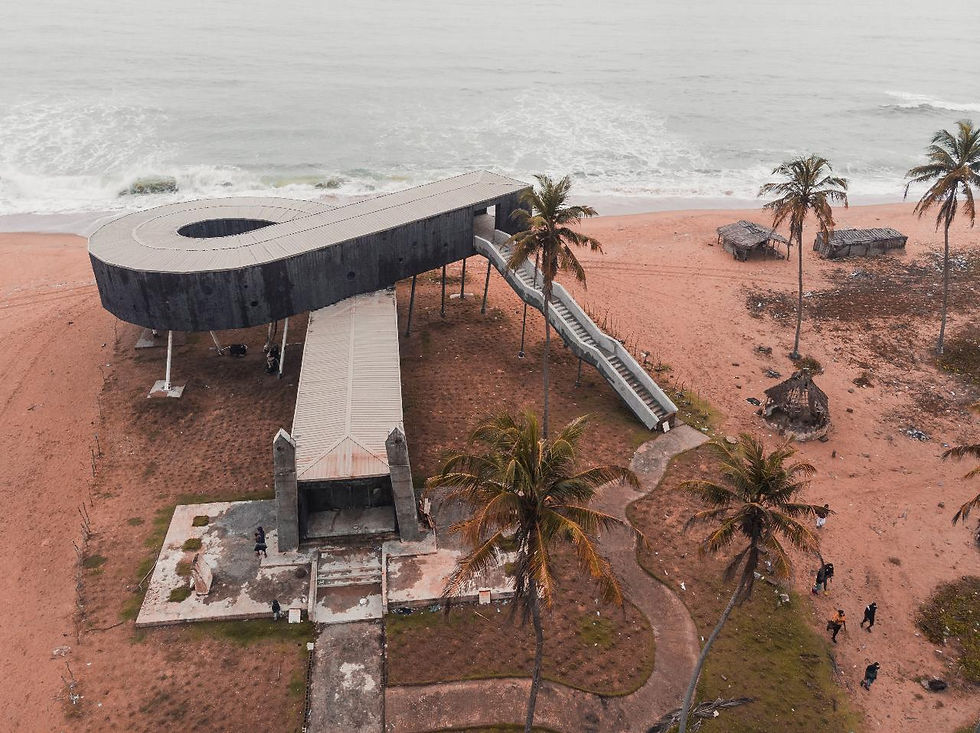
On Gberefu Island, there is a monument at the "Point of No Return." Those who entered this place until the 19th century never returned to their homeland. About three million Africans were taken from here to the plantations and mines of the Americas and the Caribbean.
The Badagry Heritage Museum documents this chapter of history through artifacts, historical documents, and replicas of the prisons and trading posts of that time. It illustrates the conditions under which people were transported, how they were auctioned at slave markets, and the economic structures that sustained the trade.
Source 2 The Statue of the Point of No Return

As a powerful symbol, these two enslaved individuals breaking their chains serve as a reminder of the era of slave traders. An era that remains deeply imprinted in Africa's collective memory to this day.
Economic and Social Consequences
The impact of the slave trade on West Africa was profound. Systematic depopulation led to a lasting labor shortage in the region, weakening agriculture and traditional craft industries. At the same time, the demand for captives fueled conflicts within African societies, as local groups became involved in the trade to gain access to European goods. These intra-African wars destabilized political structures and caused long-term power shifts that continue to have an impact today.
After the formal abolition of the slave trade by Britain in 1807, and later by other colonial powers, Badagry remained a trading hub. However, the focus shifted to natural resources, particularly palm oil, which became increasingly important for European industrial production. The economic structures shaped by the transatlantic slave trade largely remained intact: African markets continued to be oriented towards the export of raw materials, while value creation took place in Europe. This economic model, which was further entrenched during the colonial period, created long-term dependencies that still echo into the 21st century.
