
Forgotten Diaspora: Germans in America, Russia, and Latin America

Updated: Apr 28
Eight million Germans left their homeland between the 17th and 20th centuries — and shaped America, Russia, and Latin America forever. A forgotten history of migration.

Emigrating has always required the courage to start completely from scratch in a foreign land. This is true today, but it was especially so in the mid-17th century, when the first great waves of emigration began to form in Germany.
The Thirty Years' War had come to an end in 1648 — yet the political and religious disputes within the Holy Roman Empire continued. Citizens were forced to submit to the faith of their feudal lords. Agriculture lay in ruins. As feudal lords had conscripted countless peasants as soldiers, entire regions depopulated so rapidly that forests, swamps, and moorlands reclaimed them.
Wildlife multiplied so abundantly that it ravaged the fields. On top of that, Spanish, French, Dutch, and Swedish soldiers continued to maraud across the land, still fighting for supremacy on the continent.
Against this backdrop, stories and tales lured many Germans across the Atlantic — to the New World, to leave their old lives behind forever.
![German Waves of Emigration Through the Centuries. (Source: [1], own depiction)](https://static.wixstatic.com/media/66da30_a0efe4f3e3b04021a0156a8c1639e516~mv2.png/v1/fill/w_662,h_354,al_c,q_85,enc_avif,quality_auto/66da30_a0efe4f3e3b04021a0156a8c1639e516~mv2.png)
The Call of Pennsylvania
In 1677, the son of an admiral named William Penn traveled along the Rhine. He recruited farmers, merchants, and craftsmen — carpenters, linen weavers, blacksmiths — as settlers for his emerging colony on the eastern coast of North America: Pennsylvania. The English king had transferred this colony to him as a debt settlement, having been unable to repay a debt of £16,000 owed to Penn's father.
Penn encountered people who could not feed themselves from their land and had no future to offer their children. As Protestants, they feared having their faith dictated to them by others. Penn promised them religious freedom and fertile land in Pennsylvania.
Stories of the vastness and fertility of the New World spread like wildfire — beneath the radar of the ruling nobility. One such call was answered by Franz Daniel Pastorius, a man from Lower Franconia.
Germantown in America
In 1683, he arrived in Philadelphia with 33 settlers from Krefeld to found a new settlement. They purchased 16,000 hectares of land just under ten kilometers from the city. But the land turned out to be far less cultivated than the Krefelders had expected.
Philadelphia at the time offered none of the splendor of today's cities. No paved roads, no brick houses. People lived at best in log cabins. "Dugouts" were the norm — earthen holes with makeshift roofs of branches and grasses. Anyone who ventured beyond the settlement faced dense, endless forest.
In the first winter, they suffered hunger. They had no money — and in October, the month of their arrival, no time left for planting. Only with great difficulty did all the Krefelders survive that first winter. Afterward, they worked all the more industriously: they cleared trees down to the roots, cultivated flax, and processed it using machines they had brought with them into linen and textile goods, which they sold in Philadelphia. More Germans followed — new settlements were founded: Krefeld, Sommerhausen, Kriegsheim.
Their attachment to their homeland preserved the Krefelders' German identity, which they passed on to their children. This is how a dialect known as Pennsylvania Dutch survived — a blend of Palatine, Swabian, and American English.
Germantown is today a neighborhood of Philadelphia, which remains the capital of the U.S. state of Pennsylvania. Pastorius thereby laid the foundation for German overseas emigration that would continue for three centuries. The German dream of America had begun.
Marketing the New World
Penn's stories were still resonating 30 years later. The young vicar Joshua Harrsch set off for England, intending to travel on from there to America. But in London, no one wanted anything to do with him. It was only with British agents representing the Crown colonies that he struck a chord: investors and large landowners were demanding financial support from the Crown for settlement — in order to unlock the riches of the New World for themselves.
They too were looking above all for three types of settlers: farmers to cultivate the land, craftsmen to build the towns, and laborers to extract natural resources. They agreed to finance Harrsch's passage — on one condition: he was to recruit more settlers. Harrsch then authored a book under the pseudonym Joshua Kocherthal: "Ausführlich- und umständlicher Bericht von der berühmten Landschafft Carolina/ In dem Engelländischen America gelegen" ("A Detailed and Thorough Account of the Famous Land of Carolina, Located in English America").
His audience called it simply the "Golden Book" — for its gold-edged pages. In it, Kocherthal promised an earthly paradise in American Carolina — written by a man who had never set foot on American soil and was living in Eschelbronn in Baden.
In 1708, 55 Germans set off northward along the Rhine. Their journey did not go unnoticed: in towns large and small, residents gave them food or offered them shelter for the night, while in the evenings, around the fire, they told the most extraordinary stories about America. Thus Kocherthal and his Golden Book became the spark that ignited the first mass German emigration to America.
From Hope to Misery
In 1709, Kocherthal returned from New York to seek further support from the British Crown — for the settlers' living conditions were dire. In Rotterdam, he encountered 900 more Germans who had set out with their wives and children, inspired by his Golden Book and with no idea that Kocherthal had fabricated everything.
Every time a ship took Germans toward London — and presumably onward to America — word spread immediately throughout the hinterland. Rhine boatmen carried the news at every landing stage, drawing ever more fortune-seekers. The number of would-be emigrants gathering in Rotterdam swelled to 13,000 — all waiting for permission to continue their journey to America.
Dutch poor relief groaned under the burden. The British envoy on the ground had to answer uncomfortable questions: who had filled the Germans' heads with all that nonsense about land grants in the English colonies of North America?
At the same time, conditions in the holding camps grew ever more unsanitary. The chaos continued in London, where the Germans quickly filled every inn and warehouse. Around 8,000 camped outside the city in 1,600 wigwams. 140 children were sold as domestic servants, 320 young men enlisted in the military — and 1,000 died from filth, exposure, and disease.
Londoners discovered a new weekend pastime in gawking at the German refugees. Since hardly anyone knew the Germans, they were lumped together under the name "the Palatines." Donations and goods in kind flowed generously — which in turn enraged London's own poor, who had never received such help. The tensions erupted into fights. The Crown was ultimately compelled to intervene: Catholics were deported — Protestants were allowed to stay.
British Calculation Helps the Germans
British officials sought ways to settle the German migrants within the Empire as profitably as possible. North America presented itself for two reasons: the Germans were to secure England's territories against the French and indigenous peoples — and to solve a tangible economic problem.
The Empire lacked pitch and tar to waterproof the planks of its ships. Both were derived from tree resin. England itself, however, did not have enough trees to keep pace with the fleets of its geopolitical rivals, and was forced to purchase resin at great expense from Sweden. Now it sensed an opportunity to break free from this dependency.
The Crown gave the German migrants little say in the matter. Nevertheless, they organized themselves. They no longer wanted to perform forced labor or pay dues in kind, no longer wanted to be tenants on someone else's land — but to finally own property.
White Slaves in the Free World
That was precisely what remained denied to the German settlers even in America. The Crown had long since exhausted its generosity toward the colonists and financed the enormous undertaking primarily through private investors. The government advanced the costs of passage, equipment, and upkeep; private investors financed the construction of plantations and the establishment of manufactories. There the Germans were to produce ropes, planks, and other shipbuilding materials — but above all, resin.
Only once they had worked off all the costs advanced to them — for lodging in London, the Atlantic crossing, and settlement — would each receive 32 hectares of land. That was more, however, than the largest farmers in their home villages had ever owned. This was called the Redemption System. Many experienced it nonetheless as slavery.
In 1710, 2,500 newcomers arrived in New York — 446 had not survived the crossing, falling victim above all to "Palatine Fever," a typhus epidemic. The city at the time had barely 4,500 inhabitants and was overwhelmed by the mass of arrivals. Once again, they wintered in wigwams.
There the Germans' debts continued to grow — even after they reached their new home in Livingston in 1711. Tools and materials were lacking. Thick branches and stones served as makeshift plowshares — a regression to the Stone Age. Moreover, none of them had any experience tapping resin from trees. Rebellion followed.
All threads converged in Robert Hunter: he was simultaneously spokesman for the private investors, Governor of New York, Colonel of the English Army, and chief of police. He resolved these massive conflicts of interest not infrequently to the detriment of the German migrants. They had no chance against the soldiers — whose upkeep they were required to fund.
German Indian Diplomacy
A year later, the private investors went bankrupt. The Germans were forgiven their debts — but they still received no land. The communities in Livingston dissolved: many moved back to New York, where they scraped by as day laborers and craftsmen; others went to New Jersey. Some remained.
The German Conrad Weiser had used the waiting period in New York and Livingston to explore his new homeland — and in doing so had made contact with the indigenous peoples, above all the Iroquois, whose language and culture he studied.
He now set out with fifty families, purchased land from the indigenous peoples at a pittance, and settled there. There was likely no formal contract. Without food assistance from the English, the fourth winter was the harshest they had ever endured — a memory that their descendants carry to this day as "pain and tears."
The fifth winter, however, went remarkably well. The Indians taught them to grow beans and corn. The harvest even produced surpluses, which they sold in New York — in order to buy plows, pitchforks, and draft animals.
Mixed marriages occurred — most often between German women and indigenous men. The Iroquois chief Tiyanoga is said to have been married to the German Anna Margareta Schutz; their daughter in turn married the German Jacob Zimmermann.
The settlements and farms grew, new villages emerged. Pastor Kocherthal held church services. More Germans arrived — though some acted recklessly, seizing land without compensating the indigenous peoples.
The English had actually forbidden settlement there. But now they quietly and covertly used the Germans as border posts: the settlers pushed the boundaries of the colony into indigenous territory — without the expense of forts or military campaigns.
Germans Caught Between the Front Lines
Conrad Weiser Jr. had followed in his father's footsteps, mediating between the Iroquois, the colonists, and the British soldiers — all of whom he knew personally. Among his conversation partners was a certain Benjamin Franklin, who at the same time warned against the "Germanization" of the English colonies: the Germans were not learning English, and in entire neighborhoods the German language dominated the urban landscape.
In 1753, the colonists allied with the Iroquois as war with France threatened to escalate. The French, together with their indigenous allies, invaded from Canada in an attempt to connect their Mississippi territories with Canada — directly threatening the German farms in Pennsylvania, Maryland, and New York. In the end, the English prevailed — not least thanks to Hessian mercenary soldiers, many of whom ultimately remained in America.
The Move Southeast to the Danube
While the Rhine drew Protestants to America, the Danube led primarily Catholics from the southern German lands into the Balkans.
For centuries, Austrians and Ottomans had faced each other across the Western Balkans. The Austrian Emperor had already settled Germans along the Military Frontier for defensive purposes. Following the final withdrawal of the Ottomans, the systematic settlement of the devastated no-man's-land began: southern Hungary, the Vojvodina in present-day Serbia, and the Banat in Romania.
Here too, they were met by malaria-ridden swamps, which they transformed into fertile farmland through painstaking labor. Life was so harsh that this saying was handed down:
"For the first, death; for the second, hardship; for the third, bread."
Between 1762 and 1764, some 150,000 farmers and craftsmen were recruited from southern Germany. There they entered into competition with the Croats, Serbs, Magyars, Bulgarians, and Romanians already living in the region. Through intensive farming and modern methods of animal husbandry, the Germans transformed the region into the breadbasket of the Habsburg Monarchy. The settlers, now known as the Danube Swabians, achieved remarkable prosperity along the blue river.
The German Push Eastward
Germans had been migrating eastward long before the 18th century. Between the Crusades of the 11th century and the Black Death of the 14th century, numerous Jews fled the Rhineland — blamed for spreading the plague — eastward into the Kingdom of Poland-Lithuania. Under Catherine the Great, they were later assigned a clearly defined settlement zone — the so-called Pale of Settlement — in present-day Baltic states, Belarus, and Ukraine.
In individual cities, they made up as much as 30 percent of the population. With the Ashkenazi Jews came Yiddish to Eastern Europe — a language whose core was Middle High German, enriched with Hebrew, Aramaic, and Slavic elements.
Between the 12th and 15th centuries, the "Mongol storm" had decimated the local population in the steppes of Hungary and the Carpathians. Into this void settled the Zips Germans and Carpathian Germans, who in some areas made up as much as a third of the population — including in present-day Bratislava.
The German Bohemians, German Silesians, and German Moravians — later grouped together under the term "Sudeten Germans" — settled in the 12th and 13th centuries in regions that plague epidemics and the Thirty Years' War had depopulated.
All of these groups settled outside the contiguous German-speaking territory, forming linguistic islands that survived well into the 20th century. And in almost every case, they enjoyed privileges and cultural dominance over other ethnic groups — a circumstance that would help shape the conflicts of the 20th century.

Setting Out for Russia
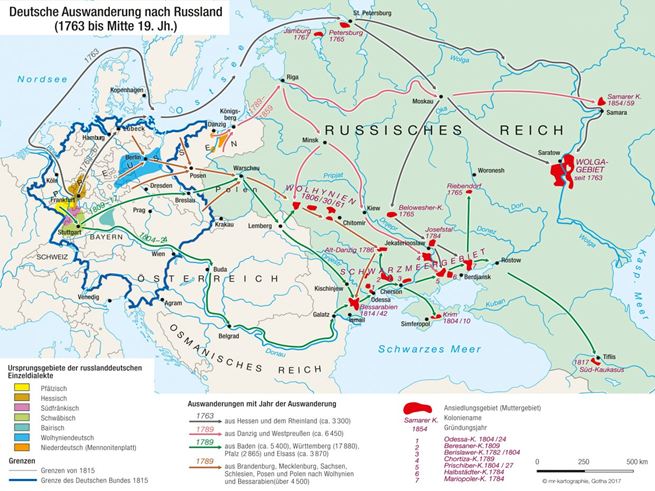
In 1762, Russia also entered the business of German settlers in a major way. Much like the Habsburgs, Russia possessed vast empty expanses in the south: around the northern Black Sea, from the eastern Balkans deep into the Central Asian steppe — cleared by the retreat of the Ottomans.
But while America and Austria advertised fertile stretches of land, Russia's marketing remained rather clumsy. The Tsars initially regarded the settlers — much as they did their own people — more as livestock than as human beings.
Only on a second attempt did they succeed in attracting Germans — with a package of privileges: exemption from taxes, duties, and levies for 30 years, religious freedom, even for Jews, loans for housing, tools, and livestock, duty-free market days, and their own community administration. Military service and the billeting of soldiers were also waived. The price: an oath of loyalty to the Tsarist Empire.
Since at the same time the feudal obligations owed to the domestic nobility were becoming ever more oppressive, around 23,000 Germans set out eastward — above all farmers from the regions around Gießen, Fulda, Aschaffenburg, and Frankfurt, who could no longer feed their families. Their treks led neither across the Rhine nor the Danube this time, but to the port of Lübeck for embarkation.

The Betrayal of the Settlers
Free choice of location was soon out of the question. Most settlers were assigned to the Volga region — for the colonization had one sole purpose: to increase the number of subjects, open up agricultural land, and fortify the vast steppes against the nomadic peoples of Central Asia.
Once they arrived at the Volga, the settlers were quickly left to their fate in the remote steppe around Saratov. Some of their privileges were stripped away before long. The land remained Crown property under hereditary lease, could not be inherited — and the authorities dictated the precise terms of how it was to be used. Here too they encountered Kazakh indigenous peoples, with whom the Germans maintained shifting and often volatile relations.
Together with them, the Volga Germans joined the 1774 uprising under the Cossack Yemelyan Pugachev and 3,000 of his warriors against the authorities. The revolt failed quickly — escape was impossible: penniless in the vastness of Russia, long since dispossessed in their old homeland. Yet the land was so fertile that the Germans made their peace with the situation. They built churches, schools, and community halls, and worked as farmers and craftsmen.
From 1812, settlement expanded further: Germans settled in Bessarabia, along the Black Sea coast, the Crimea, the Sea of Azov, and as far as the Caucasus. Some were even drawn to Siberia. Since Russia lagged far behind the western nations in industrialization, farmers were above all what was needed — and the Germans built a flourishing agricultural sector and a significant grain hub around Odessa and Bessarabia.
Along the Volga, the Germans pushed ever deeper into the steppe as fertile land grew scarce. Between 1848 and 1867, 66 new German-Russian settlements were established along the river.
In the American War of Independence
After the French and Indian War, the English sought new sources of revenue and began taxing the American colonies ever more brazenly — without the colonists having any say in London. They felt degraded to second-class citizens.
With the "Intolerable Acts," London interfered so deeply in their everyday freedoms in 1774 that even many German Americans had reached their limit. The 13 Crown colonies declared independence — and London had long since prepared for it.
London had already been negotiating with the Hessian Landgrave Frederick II. He agreed once again to send 12,000 of his "subjects" as mercenary soldiers to war in America. This shocked the great minds of the age: Friedrich Schiller (in retrospect) and Immanuel Kant called the practice human trafficking. Voltaire compared Hesse's conduct to the selling of cattle to a butcher in France. But the Landgrave needed money.
France, America's ally, was doing nothing different on the other side of the Rhine. Yet Frederick II faced growing competition in recruitment from Austria, Russia, and Prussia, all of whom were also recruiting troops and settlers. Only with great difficulty did he scrape his forces together from across Europe.
The "mercenary soldiers" even found their way into the American Declaration of Independence — as an instrument of tyranny. For German Americans, the printing firm "Steiner und Cist" in Philadelphia produced a dedicated German translation..
German Americans for Independence
George Washington initially regarded German Americans with suspicion. Many were still working off their Redemption debts to American landowners. Some had simply been deceived — the medical assistant Carl Büttner, for instance, was reportedly promised that he would live as a free man after two years of work. Once he boarded the ship and had no means of escape, he was forced to sign a six-year contract. The alternative: sale as a slave to Barbados.
Whether the German migrants would not simply join the Hessian mercenaries was therefore far from certain. But things turned out differently. Many had come to value the civic freedoms of the New World — and fought instead on the side of the Americans.
A German Battalion was formed, led by German officers — with further units soon to follow. German Americans infiltrated Hessian barracks as agitators, distributing pamphlets stirring up anti-British sentiment.
At the decisive Battle of Yorktown in 1781, roughly one third of the combatants on both sides were German-speaking — which is why it entered history in some accounts as the "German battle."
Hardship Breeds Yet More Refugees
For many Hessian farmers and master craftsmen, the mercenary army meant a massive hemorrhage of labor and a path into poverty. For the landed gentry, it meant a bleeding dry of taxpayers and conscripts.
Frederick II had therefore issued an emigration ban. Many young Hessians deliberately exploited the wave of recruitment to circumvent it and gain a foothold in America — never intending to return. When Washington's army defeated the English at the Battle of Trenton and captured numerous mercenaries, he offered them land — and many accepted. 3,000 of the 18,970 Hessian soldiers in total remained in the New World. Hundreds of thousands from the impoverished Hesse would follow in their footsteps.
Overpopulation Causes the Barrel to Overflow
Around 1815, Germany was seized by profound change. In Britain, industrialization was unfolding in full force, flooding Europe's markets with cheap goods — much as China does today. Prices collapsed, while at the same time a rapid surge in population took hold.
Labor markets grew tight — for linen weavers, cobblers, carpenters, and blacksmiths alike. Farmland too was becoming increasingly scarce for peasants due to overpopulation.
Reliable statistics from that era are lacking, yet beneath the surface emigration grew steadily — much to the displeasure of the authorities, who complained about the drain of taxpayers and workers caused by their subjects' "emigration craze." They made departure as difficult as possible at every turn.
By 1838, Germany's unemployment stood at an estimated 30 percent. Those in power failed to notice that poor relief was already at its limit — and thus also that the waves of emigration were likely saving the system from collapse. The situation worsened further when potato blight swept across Europe in the 1840s, driving Germans abroad in even greater numbers. Ironically, the potato itself originally came from America and had first contributed to Europe's population growth.
Hardship Creates a Smuggling Industry
The emigrants staked everything on a single card: they sold all their possessions and set out. Within their village communities, they prepared together. One person was sent ahead to scout out a suitable location on the prairie for the group. Those who stayed behind were kept up to date by post.
This journey was, in those days, a farewell with no return. The crossing on a three-masted sailing ship took six weeks — arduous and dangerous, especially for children, who were vulnerable to dysentery and other diseases. Diarrhea could drain them dangerously within a short time.
The shipping companies allowed each family only one trunk for their last belongings. If departure was delayed — by bad weather, for instance — the waiting time devoured their savings before the journey had even begun.
Shipowners crammed as many would-be emigrants as possible onto a single vessel. Three times a day there was strictly rationed drinking water and food: porridge, ship's biscuit, salt meat, herrings, or stockfish. After three weeks, algae floated in the water and maggots in the porridge. On French or English ships, passengers had to bring their own food — or buy it on board at great expense. Some starved before they even reached land.
Yet millions more Germans followed — spurred on by letters reporting a better life, and wisely saying nothing of the initial hardships.
In this way, a veritable emigration industry took shape — not unlike the people-smuggling industry that today brings people from the Global South to the West. In the 19th century, five million Germans set out for all corners of the world: Algeria, Brazil, North America, and Russia. Hamburg became Germany's gateway to the world.

Fortune Favors the Bold
Some set out carrying memories of the civic freedoms enjoyed under Napoleonic occupation — freedoms they wanted back. On top of that, land on credit beckoned. Most came, therefore, for economic reasons.
Jakob Astor, Levi Strauss, Henry Heinz, Eberhard Anheuser, and Adolphus Busch — all entrepreneurs of German origin who in that era laid the foundations of their empires. But most German emigrants had no such grand ambitions.
In their German home villages, a strict sense of class distinctions prevailed: who you were was displayed through clothing, jewelry, and the number of servants you kept. The fear of social decline was ever-present: those who were still getting by could see their children heading for a hard fall.
In the United States, none of that counted. The emigrant groups were a colorful mix — farmers, craftsmen, small traders, and academics side by side. The American authorities wanted to populate the vast prairies; the Germans above all wanted one thing: to escape their hopeless situation at home. The two needs complemented each other perfectly.
The number of German newcomers rose rapidly: 80,000 in 1847, already 176,000 in 1852, and as many as 239,000 in 1854.
America's Myth: From Dishwasher to Millionaire
After arriving, the journey continued into the interior — by rail, riverboat, and carriage. At their destination, they were met by the advance scout who had already reconnoitered the area.
He briefed the newcomers: oxen were better than horses — hardier and cheaper. Corn was the best grain, and John Deere's plows were purpose-built for the prairie.
The Germans staked their claims. As so often, the first shelter was an earthen dugout with a grass roof — in temperatures of up to 20 degrees below zero. Gradually, acquaintances from the home village arrived, and people helped one another with building, plowing, and harvesting.
Before long they were harvesting surpluses and selling milk and butter to the towns. Everyone started from scratch — and only after several years did it become clear who had been the most industrious and who owned the largest farm.
The land seemed wide enough for all. Women were sought as wives, men for the countless tasks that needed doing. The American expanses allowed the Germans to develop their potential in ways that the noble lord or the clergyman back home would never have permitted them. The rise of American industrial cities like Pittsburgh also attracted German entrepreneurs and skilled workers. Craftsmen settled in New York, New Jersey, Pennsylvania, and the Midwest — as bakers, tailors, butchers, brewers, or cigar makers.
The Germans became the largest immigrant group in the United States. In some places they soon formed the majority — and named towns after their old homeland, such as the quiet community of Schaumburg in Illinois.
The Lost Paradise of the Indians
But even in the West, land quickly grew scarce. Anyone who arrived as a newcomer and wanted to keep pace had to push ever further westward. The drive for freedom that propelled Europeans toward the Pacific steadily curtailed the freedoms of the indigenous peoples.
In 1843, present-day California still belonged to Mexico as "Alta California." Alongside the United States, Britain, France, and even Russia had staked claims to the region. At the same time, Spanish-speaking Californians under the Junta of Monterey were pushing for an independent republic, while Anglo-Saxon settlers sought annexation by the United States.
In the middle of this web of competing interests, the Swiss-German Johann August Sutter had founded a private colony in a strategically advantageous location: "New Helvetia" — better known as Sutter's Fort. Like a spider at the center of a web, he cultivated business relations with all the players. The United States used the site as a launching point for their westward expansion and ultimately conquered California in 1848 in the war against Mexico.
A New Beginning in New Helvetia
In search of a better life, the Swiss emigrant Heinrich Lienhard made his way to New Helvetia. In a manuscript written retrospectively in 1870, he vehemently contradicts the heroic American narrative of the "Winning of the West" — his account is among the rare empathetic testimonies about the fate of the indigenous peoples.
For several years Lienhard lived apart from the white settlers, coming into contact with indigenous villages. He later took charge of overseeing the indigenous workers of the region. On one occasion he overheard their melancholy accounts of life before the whites had driven them from their land — conversations heavy with powerlessness.
By then they were living in conditions akin to slavery: at night, indigenous workers were locked in cages, forced to eat from pig troughs, and deliberately degraded to the level of animals. Sutter kept female sex slaves. The situation escalated when gold was discovered at Sutter's Mill and tens of thousands more settlers poured into California. Violence against the indigenous peoples exploded — they were driven from their claims.
California legalized forced labor, sealing the fate of the indigenous peoples: their systematic displacement followed, clminating in deadly attacks.
Lienhard could not reconcile this with his moral values and left the supposed paradise — which was built on slavery no less than the old world had been.
Sutter's Fort is today known as Sacramento, the capital of the U.S. state of California.
The Forty-Eighters: The End of the Springtime of Nations Lets America Flourish
In 1848, the revolutionary wave swept from France into the German lands and principalities. The people rose up against the Prussian authorities — but the authorities crushed the revolution. Many leaders were executed, imprisoned, or driven into exile.
Many political prisoners were offered release — on the condition that they emigrate to the United States. Via stopovers in France, England, or Switzerland, the revolutionaries arrived in America as the so-called "Forty-Eighters".[1]
With between 4,000 and 10,000 political refugees, they formed a small but intellectually and politically highly active elite — among the millions of Germans who came to the United States between 1848 and 1860. The majority of those millions were economic refugees fleeing the potato blight.
The Forty-Eighters, by contrast, were well-educated liberals, radicals, and intellectuals — lawyers, journalists, teachers, and officers. Their flight was driven less by economic motives than by the liberal values that had brought them into conflict with Europe's ruling authorities. They rapidly came to dominate the German-language press with social reformist ideas — as founders, editors, and columnists.
Inclusive Institutions Reach America
They also brought with them pedagogical ideas that had been banned in Prussia: early childhood education through play rather than drill and obedience. In English, this approach survives to this day in a single German word: Kindergarten. They thought no less reformingly about school education — discussion, independent thinking, and physical exercise as the foundations of free citizens found their ay into America.
The Forty-Eighters founded a multitude of associations of "free men": men's choirs, book clubs, shooting clubs — and above all gymnastic associations (Turnvereine), which under the umbrella organization of the "Socialist Turner Federation" were highly political organizations. Gymnastic instruction took place in around 60 cities — to preserve German traditions and train combat-ready, free citizens. They sought to maintain their own ethnic identity — as a resource for the ongoing struggle for a free Germany.
They now turned their attention increasingly to pressing issues in America: labor protection laws, direct election of the President and Senate, freely accessible education, affordable land for settlers, and public reform.
![The Arriving Forty-Eighters Found Newspapers and Gymnastic Associations. (Source: [2], own depiction)](https://static.wixstatic.com/media/66da30_27a6cceb44474d69ac750551c59ac199~mv2.png/v1/fill/w_661,h_386,al_c,q_85,enc_avif,quality_auto/66da30_27a6cceb44474d69ac750551c59ac199~mv2.png)
Germans Against Slavery
One cause became particularly dear to them: the fight against slavery. The "Turners" regularly provided bodyguards for anti-slavery activists, protecting their public agitation. They embedded slavery within a broader discourse on freedom and equality:
"The problem of slavery is not the problem of Black people. It is the eternal conflict between a small privileged class and the broad mass of the non-privileged — the eternal struggle between aristocracy and democracy."
Until then, traditional German Americans had preferred to vote for the Democratic Party. The Forty-Eighters, however, threw their weight behind the Republican Party — founded only in 1854 — whose anti-slavery course better matched their libertarian ethos and belief in social advancement through free labor.
In 1860, they forced a programmatic decision at the party convention in Chicago: the so-called "Dutch Plank" — a pro-immigrant clause pushed through against the resistance of the anti-immigration Know-Nothing movement. In return, the Forty-Eighters delivered the German American voter bloc to the Republican Party. Abraham Lincoln was elected the 16th President of the United States.
The Turners Win America's Civil War
In 1861, the American Civil War broke out. Around 95 percent of the Union Army were volunteers — fighting to preserve national unity and against slavery. The Forty-Eighters were represented disproportionately and motivated tens of thousands of German Americans to enlist. With 200,000 soldiers, German Americans provided the largest foreign contingent in the most costly conflict in U.S. history.
The Forty-Eighters exerted their influence through local newspapers, associations — above all the Turner clubs — as public speakers and as an inspiring example: they fought themselves on the front lines. The result: higher enlistment rates and significantly fewer desertions.
Many Forty-Eighters brought military experience from the German Confederation or the Revolution of 1848. The Turners were trained in arms and frequently served in their own volunteer regiments. Three of the six foreign-born Major Generals in the Union Army — the second-highest rank — were Forty-Eighters, including Franz Sigel, who commanded the almost exclusively German 3rd Missouri Infantry Regiment.
The literature on the Civil War still regularly acknowledges their contribution.
The Long Shadow of the Forty-Eighters
After the Civil War ended in 1865, their public role diminished — but the Forty-Eighters continued to exert influence behind the scenes. Many made names for themselves as scholars, engineers, and intellectuals. In 1865, the revolutionary Mathilde Franziska Anneke founded the Milwaukee Töchter-Institut for equal education of girls in physics and natural sciences. In 1869 she was involved in founding the Wisconsin Woman Suffrage Association, and in 1876 she contributed to the first socialist organization of German American women in Milwaukee.
In parallel, the Forty-Eighters brought the idea of organized labor to the New World: Wilhelm Weitling founded the Bund der Arbeiter in 1850, and Joseph Weydemeyer carried Marxist class analysis into America's public debate. German migrants made up as much as half of all union members in New York — they fought for the ten-hour working day and the prohibition of child labor. Milwaukee became the most German city in America and a stronghold of anti-slavery activism. The German-backed Socialist Party of Milwaukee won the election in 1910 and governed the city for five decades.
Their influence can be traced even decades later: between 1909 and 1965, local chapters of the National Association for the Advancement of Colored People (NAACP) were founded disproportionately often in cities with a strong presence of former Forty-Eighter communities. [2] [3]

The Germans Conquer Latin America
In Latin America, too, governing meant above all populating undeveloped land. Countries such as Argentina and Brazil, with their unstable governments and poorly developed hinterlands, could barely compete with the appeal of North America. Moreover, industry was booming in Germany itself toward the end of the 19th century — those willing to emigrate were no longer so easy to find.
The solution was found, of all places, among the Germans in Russia. There too, land had by now grown scarce. Tsar Alexander II used the new balance of power in 1860 to strip the Germans of their century-long preferential treatment and place them on equal footing with Russians — which meant military service and taxes. Their privileges had never been committed to writing, but passed on orally from generation to generation.
The Germans had never truly adopted Russia as their homeland. Even after three or four generations, they remained tenants on the Tsar's land. Now they had to experience what it meant to send their own sons to war for a country that was not theirs. At the same time, divisions grew among them: those who now wished to purchase the land they had leased could do so — but only the wealthiest farmers had the necessary funds. The less affluent had to sell and remained tenants. Inequality ate away at communities that had once been tightly knit.
In 1875, around 300 Volga Germans emigrated to Canada, and 200 to Brazil. As the threat of Russification showed no signs of abating, 100,000 more made their way to Latin America around the turn of the century. Many stopped over in Germany along the way — a country they themselves had never known, but which their parents and grandparents had always called the "old homeland." They traveled on to South America and learned, after German and Russian, their third language: Spanish.

Destination Argentina
Argentina moved into focus — the country was seeking immigrants to build out its railway lines and work its plantations. In return, land and bridging loans beckoned. But expectations collided: the Russian Germans knew enclosed, small-scale villages — Argentina's large landowners thought in terms of gigantic individual farms. A compromise was reached: shared village pastures and cultivated plots that rotated between families. As free land grew scarcer in North America, more Germans flocked to Argentina and made the land arable.
At the embarkation ports, agents pressured Germans looking to emigrate to buy tickets for Brazil rather than Argentina. There too, regional administrations were desperately competing for immigrants — and even paid the Germans' passage.
For after Brazil finally abolished slavery in 1888 after 400 years, labor was urgently lacking in São Paulo — above all on the coffee plantations. Alongside many Italians, 21,600 Germans arrived at the end of the 19th century, most of them destitute families. Since plantation owners often bore little or no transport and accommodation costs for European workers, these were ironically even cheaper than the enslaved workers had been before.

America is De-Germanized
In 1910, of 92 million Americans, more than 8 million had German roots of the first or second generation. They helped drive the industrial rise of the United States: in steel production, mechanical engineering, leather and meat processing, they accounted for a disproportionate share of skilled workers — and brought artisanal and industrial know-how from Germany into the American economy. And not least, they introduced America's new national drink: beer.
But in 1914, the German Empire plunged Europe into war. Although no serious German American party organized itself in support of Germany, the loyalty of German Americans was immediately called into question. Anti-German rhetoric spread across the United States. In John Dos Passos' USA Trilogy, Germans were portrayed as "Huns massacring Belgian babies." The headlines dripped with anti-German xenophobia.
With America's entry into the war, German American culture was practically wiped out overnight. In 1918, 30 states banned German-language instruction. German-language newspapers and sermons were banned or censored, German was prohibited in public spaces, German books were removed from libraries, and prominent German Americans were interned. Sauerkraut became "Liberty Cabbage." Trade unions rejected membership applications from Germans.
Dual citizenship aroused suspicion. Germans had to prove their loyalty to the United States without gaps — many denied their origins entirely. Mobs lynched German Americans, tarred and feathered them. The First World War turned Germans in many places into an unwanted minority.
The purges were so thorough that the group which, more than almost any other, had contributed to the industrial and cultural rise of the American world power and helped lay its socio-political foundations, vanished from public life within just a few years.

Germans Now Unwanted
After two centuries of migration history, the United States drastically curtailed immigration with the Quota Act of 1921 — only 70,000 Germans were permitted to enter per year.
The roughly 1.8 million Germans in the Russian Empire — from Volhynia in western Ukraine to the Volga colonies — lost their colonial self-governance with its own language, schools, and church communities following the Bolshevik Revolution. Clergymen were deported or shot. Their cultural and social infrastructure was systematically destroyed. Many fell victim to Stalin's purges. Independent farmers — the so-called kulaks — were expropriated, and famines struck the German settlements.
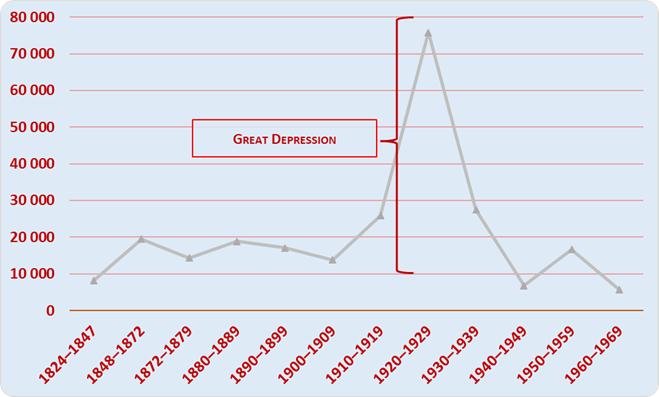
Germany emerged from the First World War as the Weimar Republic — but the new state could not provide for its own population. The Great Depression did the rest: industry lay in ruins. Germans were regarded internationally as an unwanted group — with barely any destinations left open to them: only Brazil, Argentina, and other South American countries.
Pan-Germanism Estranges the Germans from the World
70,000 arrived in the German-speaking settlements of southern Brazil — but this time with different baggage: they brought with them conservative and nationalist values that stood in diametric opposition to the progressivism of the Weimar Republic.
The new arrivals carried Pan-German ideology into Latin America:
"Homeland is this inner space. It is not the same as fatherland. We cultivate our people's identity."
The underlying message: God calls not the individual, but peoples as a whole. Every individual must remain faithful to the traditions of their people — the greatest danger comes from mixing with other peoples. Brazil too was a German homeland, where German customs were to be preserved. They sealed themselves off and refused integration.
The Pan-German League took an active interest in Germans living abroad and propagated Pan-Germanism. The millions of Germans scattered across the world were regarded by the League as an important pillar of German society. It sent Protestant missionaries into this Catholic country, financed schools, textbooks, and German-language literature — on the back of every printed publication stood its motto:
"Never forget that you are German."
It comes as little surprise that a large proportion of Germans in Brazil welcomed Hitler's rise as an act of liberation. Brazil's NSDAP became the largest regional chapter outside Germany. Fearing separatism, Brazil was compelled to ban it — and even many of German descent turned away in disgust. National Socialism now destroyed the cultural ties between Germany and Brazil as well.
The End of Global German Culture
Everywhere, German communities became estranged from the majority population of their adopted homelands — from Russia to Africa, from North to South America. Many could barely speak the language of their new home, even after years of living there.
Places named after German towns received new names. German-language institutions were dissolved across the world. The language disappeared, the culture was abandoned, and German heritage was erased from collective memory. Germany's overseas territories in Africa were divided among France, Belgium, and Great Britain.
When Nazi Germany invaded the Soviet Union, Stalin deported around 900,000 of the Germans living there to Siberia, Kazakhstan, and the Urals. Their property was confiscated and their citizenship revoked. Many were conscripted into forced labor — the death toll ran into the hundreds of thousands. Only after Stalin's death in 1953 did a partial rehabilitation take place, yet systematic discrimination persisted.
With Perestroika from 1987 onward, a mass migration to Germany began: around 450,000 Russian Germans resettled in the old homeland — the country their ancestors had left 200 years earlier. They were called Spätaussiedler — late repatriates. By the mid-2000s, a further 1.8 million had followed.

The End of German Settlers in Central Europe
In the Second World War, German settlers in mixed settlement areas committed particularly brutal acts against other ethnic groups — such as the "Prinz Eugen" Division of the Waffen-SS against the Serbian civilian population.
The Beneš Decrees triggered the expulsion of the Sudeten Germans from Czechoslovakia — more than three million people were driven out, accompanied by violence, arbitrary acts, and deaths in the hundreds. Romania, Hungary, and Yugoslavia expropriated and expelled the Danube Swabians: starting at Christmas 1944, Stalin deported roughly 30,000 from Hungary, 30,000–40,000 from Romania, and 12,000 from Yugoslavia into forced labor in the Soviet Union; around 15,000 did not survive the ordeal. From East Prussia, long refugee columns trudged westward into the German heartland — fleeing vengeful Soviet soldiers.
At war's end, 45,000 refugees made their way to Argentina — perpetrators, fellow travelers, and opportunists of the Nazi dictatorship alike. There their paths crossed with Jewish survivors of the Holocaust. In Brazil, their colonies bordered directly on one another.
Settler Colonies Create Inclusive Democracies
The first great wave of German emigration began when the Thirty Years' War had made the land prey to foreign powers — instability and violence defined the era. Under such circumstances, it was easy to convince people of a paradise in the New World that did not exist.
The conquest of Pennsylvania unfolded over several decades. The journeys were marked by misery — the emigrants became easy victims of deception, exploitation, and debt bondage. Yet the economic interests of the British Crown — resin for the fleet, secured borders — compelled it to gradually liberalize its regime and grant settlers more rights.
In their homeland and in the eastern settlement territories, this was not the case. The Germans were lured with privileges and promises — only to have them revoked whenever the balance of power shifted. They could not develop their potential as their compatriots in America could. Back home, they were regarded as pawns — as mercenaries for foreign wars, rented out like livestock.
Not that the English had not tried something similar. But the Americans — with the help of the Germans who sided with them — repelled the ambitions of European rulers. In doing so, German Americans made a fundamental contribution to the emergence of American democracy.
The myth of rags to riches unfolded its pull. Many failed — through overconfidence or simply bad luck. But many owed America their rise into the prosperous middle class — and thereby ignited the hopes of millions back home.
Extractive Institutions Continue to Exploit
Those who stayed behind were less fortunate. Despite growing economic pressure from industrialization and population growth, their needs were suppressed — the nobility continued to treat them as disposable. When their uprisings for greater freedoms were crushed, a vast people-smuggling industry emerged, shipping millions to the New World.
With this wave of economic refugees came, once again, a liberal spirit to the United States — for among them were numerous political refugees. The Forty-Eighters built a resilient network of free men in Turner clubs, took the side of the North in the Civil War, and brought the labor movement, social reform, and new ideas to America.
For the Germans in Russia, conditions became so unbearable after several generations that they once again packed their few belongings and moved on — many to South America, where they were often sought merely as replacements for the recently abolished slavery. Only the poorest and most desperate came — and they were receptive to Pan-German ideas that simultaneously estranged them from their new homeland.
Where the Germans themselves became colonizers — in Africa, toward indigenous peoples in America — they became oppressors. The very same people who elsewhere fought for freedom drove others into slavery.
The End of the Germans
With the First World War, the German footprint faded in most host countries. Anglicization and Sovietization — censorship, prohibitions, the systematic destruction of German-language institutions — erased the overseas Germans from the collective memory of their countries. This was completed when the National Socialists seized power and plunged the world into war under a mania of ethnic purity. Three centuries of emigration history — eight million Germans across the world — came to a halt.
And yet: many countries today carry a deep German heritage within them, without being aware of it. In the United States, the Germans laid the industrial foundation for the rise to world power — and fought for the social freedoms and cultural openness that make the country a magnet for millions to this day. Today, around 50 million Americans look back on German roots.
In the 21st century, Germany itself transformed into one of the world's largest immigration nations. Thirty percent of the population were born — or have a parent who was born — without a German passport. The Germans coined their own term for this: Migrationshintergrund — migration background. [1] [4]

Further Reading
[1] S. Blaschka-Eick, In die Neue Welt! Deutsche Auswanderer in drei Jahrhunderten, Hamburg: Rowohlt Verlag, 2010.
[2] C. Dippel und S. Heblich, „Leadership and Social Movements: The Forty-Eighters in the Civil War,“ National Bureau of Economic Research Working Paper No. 24656, pp. 1-93, 2018.
[3] H. Bungert, „Deutsche "Forty-Eighters" in den USA,“ 10 02 2023. [Online]. Available: https://www.bpb.de/shop/zeitschriften/apuz/1848-49-2023/518141/deutsche-forty-eighters-in-den-usa/. [Zugriff am 12 04 2026].
[4] I. Glazier und W. Filby, „Germans to America: Lists of Passengers Arriving at US Ports 1850-1897,“ 2025. [Online]. Available: https://www.germanroots.com/gtoa.html. [Zugriff am 12 04 2026].
[1] Switzerland, alongside San Marino, was one of the few republics in Europe in the 1840s. Yet it soon came under financial and diplomatic pressure — France and the German states demanded the expulsion of the refugees. The Swiss Parliament set this in motion in 1849. Following negotiations with France, Swiss envoys escorted the refugees to the Atlantic ports, from where they were able to depart for the United States.


Comments