
Japan’s Labour Shortage: How Ol-der People, Women and Robots Are Expected to Replace Migrants

Asia’s richest country is ageing faster than any other industrialised nation. Without migration, it faces a rapid race to raise the productivity of its remaining workforce.

In the previous chapters, we discussed how migration changes societies. It shapes not only the countries to which people move, but also those they leave behind. But what does this look like in a 21st-century industrialised country that permits barely any immigration?
This applies particularly to East Asian societies such as Japan and South Korea. Both achieved prosperity remarkably quickly between the 19701970s and 19801980s and have remained highly conservative towards immigration to this day—even as their populations are ageing rapidly.
Japan and South Korea rank near the bottom of the OECD, with roughly 1.4new permanent immigrants per 1,000inhabitants annually; the OECD average is 99 immigrants. Even this figure represents growth from a low base: 36 percent in Japan and 175 percent in South Korea—primarily because of a continuing migration wave from China and, more recently, from Vietnam and Nepal.
In 2024, the share of people not born in Japan remained below 44 percent, compared with an OECD average of 11.5 percent. That average is itself lowered by traditional emigration countries such as Mexico, Poland, and Turkey.

Japan’s Barriers to Migration
With its highly industrialised economy, high wages, good standard of living, and strong employment prospects, Japan should in principle be a classic country of immigration. Yet it is not only its island geography that makes it difficult for immigrants to settle in. A rigid, tradition-bound workplace culture also makes it generally hard for newcomers to gain a foothold in the Japanese labour market.
Young Japanese people often begin working for a company while still at university. After graduation, the company typically hires them permanently and provides further in-house training. This frequently prevents outsiders from having their qualifications and skills properly recognised.
Entry-level jobs are generally poorly paid, while salaries rise substantially only at a later stage of a career. Lifetime employment remains the norm in Japan, especially in large companies. Well-qualified workers are thus tied to a company through guaranteed employment and salary increases lasting into their fifties.
Around 40 percent of employees aged 50 to 59 have never changed employer. Changing jobs is often viewed negatively. This combination makes Japan particularly unattractive to temporary labour migrants.
This is compounded by a rigid corporate culture, with average working hours of 49 hours per week. Job quality is often poor, and companies do little to prevent workplace stress, undermining employees’ mental health. The demanding process of integrating into a rigid society, together with high expectations of Japanese-language proficiency, further makes it difficult for migrants to establish themselves in the Japanese labour market.

The Ageing of Japan’s Labour Market
Together with demographic change, these factors are now producing a structural crisis of survival. With 125 million inhabitants, Japan is the OECD’s third-most populous country after the United States and Mexico. Yet among nine major industrialised economies, it is the only one with a declining population.
Eastern European countries suffer primarily from population outflows to Western Europe. Japan faces a different problem: it lacks the migrants who could offset the effects of population ageing and low fertility, as they do in other Western industrialised countries. Japan has one of the highest life expectancies in the world, while its fertility rate has fallen to just 1.14 children per woman—well below the approximate 22 children per woman needed to maintain a stable population.
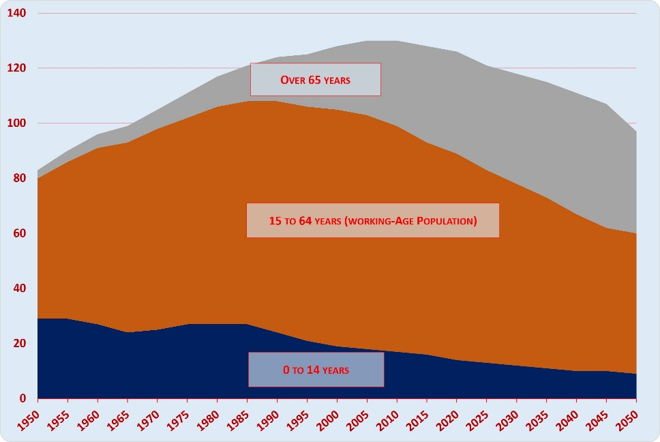
As a result, very few young people are entering the country. Between 2007 and 2021, Japan’s working-age population declined from 83 million to 74 million people, a fall of 11 percent. By 2030, it is expected to decrease further to 71 million, and by 2060, to just 51 million people of working age.
Japan’s old-age dependency ratio is the highest among industrialised countries. In 2022, for every 100 Japanese people of working age—between 20 and 64—there were 55 people aged over 65. This figure will continue to rise: by 2050, it is projected to reach 81 dependants for every 100 people of working age, assuming immigration remains as low as it has been to date.

The Shadows of Ageing
The consequences of a lack of younger generations are already clearly visible. Labour shortages have long become widespread in Japan, affecting every skill level, sector, and company size. Put simply, there are no longer enough applicants for vacant positions. The ratio of job openings to applicants stands at 1.3:1, the tightest labour market since the high-growth years around 1970. Many positions therefore remain unfilled. The number of self-employed people is also declining, from 91 per 1,000inhabitants in 2007 to 75 in 2025.
Based on the experience of the past decade, Japan could face a labour shortfall of between 2.5 and 6 million workers by 2030; by 2040, the deficit could reach between 5 and 14 million. The eventual scale of this gap, however, will depend heavily on how productivity develops among Japanese workers.
There are serious reasons for doubt on that front. In 2020, the number of young people up to the age of 29 who were neither in employment, education, nor training—known as NEETs—stood at 18 per 100 employed people, rising to 2222 in urban areas. This represented an increase of 77 since 2010. Many young people increasingly feel disconnected and overwhelmed by the burdens they are expected to carry in an ageing society.
Changing competitive conditions also make it increasingly difficult for Japanese companies to offer their younger employees the same security that their parents once enjoyed. As a result, non-regular employment has expanded: it now accounts for two-fifths of all employment, compared with one-fifth two decades ago. These jobs are less well paid and provide less training and weaker social protection.
At the same time, older people’s substantial wealth is driving up house prices, leaving Japan with some of the highest housing costs in the world. This contributes to Japan also reaching record levels of relative poverty. None of this creates favourable conditions for raising individual productivity.
The Endeavor of Productivity
Japan faces a dilemma in addressing its labour shortage. If it wishes to remain closed to migrants, it must raise the incomes—and therefore the productivity—of individual workers in order to fill labour gaps and safeguard the financial security of its ageing population. Yet this path, too, would require greater openness to foreign competition and the outside world.
Around the turn of the millennium, it was said that international experience was even viewed negatively in Japan. Japanese researchers rarely go abroad to build networks and return with new ideas and impulses. This makes Japan one of the least internationally connected industrialised countries in the world. It also affects the diffusion of knowledge and, consequently, productivity.
Following its meteoric rise to global economic superstardom in the 1970s, Japan has since fallen behind the rest of the world, with average growth rates barely above zero. Its output per hour worked now stands at only around 75 percent of the average for the upper half of OECD countries. According to recent data, Japan continues to rank near the bottom of the G7 in labour productivity.
Japan’s ageing population has little interest in exposing itself to greater competition, in which many may no longer be able to keep pace. The same applies domestically: the state subsidises the survival of old firms at the expense of young, innovative businesses—even when their business models have long ceased to be viable and they are avoiding restructuring at the public’s expense.
Three quarters of all small and medium-sized enterprises in Japan are more than ten years old, compared with fewer than half across the rest of the OECD. Small firms prefer to remain small in order to avoid losing numerous advantages. This is particularly evident in the healthcare and long-term care sector, which is governed in a highly egalitarian manner, further constraining its development and adaptation to future challenges.
Crises such as COVID-19 therefore leave deeper scars in Japan than in other industrialised countries. Productivity growth remains weak and is only slowly beginning to catch up with the rest of the world.
Older Workers and Women Step In
Despite the bleak outlook, the Japanese government and business community broadly agree on one point: labour shortages should primarily be addressed by tapping the full productivity potential of the workforce and by mobilising women and older workers.
So far, however, the productivity drive has delivered fewer results than hoped. More than 60 percent of small and medium-sized enterprises invest in automation and training, but only 31 percent actively seek to recruit women and older workers.
Labour-market reforms—including equal-treatment legislation and easier job mobility—have at least helped soften the sharpest decline in the workforce. Between 2007 and 2022, more than one million women and four million people aged over 65 entered the labour market, while three million men left it. Employment thus remained relatively stable; with a labour-force participation rate of 80.6 percent, Japan remains among the global leaders.
However, the total number of hours worked has remained constant. Part-time work is often voluntarily undertaken by married women. Traditional attitudes persist, while social infrastructure is frequently inadequate; this encourages women to leave paid employment in order to care for children or elderly relatives. Without a comprehensive expansion of social infrastructure, the potential of such structural reforms will therefore remain limited.
Existing structures are also poorly suited to older workers. Japan continues to adhere firmly to retirement at the age of 60. Afterwards, older people often struggle to find new work—usually in positions below their qualification level and with substantial pay cuts. In most cases, they are rehired by the same company after retirement, but on inferior terms. Older people in Japan are employed at above-average rates, but they generally work only a small number of hours in order not to lose state benefits.
This, too, often affects older people whose pension entitlements are insufficient—most commonly women. Government reforms to date have shown only limited effects. They have generally come at the expense of working conditions and pay, whereas dismissals remain rare in Japanese companies.

Robots as an Alternative
Japan was once at the forefront of automating work processes. The country still invests 3.3 percent of its economic output in research and development—more than most other industrialised countries.
For a long time, robots in Japan substituted for missing migrants. The density of industrial robots per 1,000 employees is among the highest in the world, particularly in manufacturing. Yet precisely because automation in this sector is already so advanced, major further productivity gains are unlikely.
Offshoring production processes could, in principle, compensate for the lack of migration in a different way. So far, however, Japanese companies have been motivated primarily by the prospect of entering large, rapidly growing foreign markets, rather than by the intention of easing labour shortages at home. Service-sector jobs in agriculture or care work cannot be offshored in any case.
Nor have the effects been entirely positive, as the introduction of robotics into the care sector illustrates. It has reduced the physical demands of the work. Field studies found no decline in employment, and workers remained loyal to their employers—but their wages fell.
Overall, automation may reduce demand for less-skilled workers, but it also increases demand for workers capable of performing more complex tasks. The shortage is therefore not eliminated; it is merely shifted to other sectors.

Rigidity Prevents Adaptation
New technologies such as artificial intelligence could raise productivity, improve working conditions, and complement existing skills. Japanese people themselves are highly receptive to such innovations. Yet Japan’s tradition-bound society makes it difficult for new business models built on them to gain a foothold.
The same structures that make life difficult for migrants also hinder young Japanese people in adapting to the changing conditions of the global economy. Labour mobility between firms remains low, business practices are rigid, and regulations further distort competition.
This is also reflected in skills. While Japanese people perform strongly in reading, writing, and numeracy, they tend to lack problem-solving skills. The idea of lifelong learning is also still not widely established. As a result, new business models struggle to break through.
Japan therefore risks falling behind in many areas. AI use is lower than in other industrialised countries, and so is its potential effect in easing labour shortages. Only 55 percent of Japanese firms use generative AI, compared with more than 90 percent in Germany and the United States. At the same time, this also points to considerable untapped potential. What is lacking, however, are the skilled workers able to implement such innovations.
The key to Japan’s challenges therefore lies, above all, in its young and well-educated generation. Young people achieve some of the highest scores in the PISA rankings, while workers also perform strongly in measures of occupational skills.
No Funding for Progress
Weak economic growth and population ageing have pushed Japanese public debt to several hundred percent of annual economic output. This places an additional burden on younger generations, while investment remains limited. Japan’s gross general-government debt was estimated at 240 percent of GDP in 2025.
For a long time, Japan faced persistent deflationary pressure. The resulting culture of saving, together with growing pessimism about weak growth prospects, continues to encourage Japanese citizens to hoard substantial wealth. Rather than investing in the future and in productivity growth, Japanese companies have accumulated the largest cash reserves among advanced economies.
Foreign direct investment in Japan also remains among the lowest in the OECD: inward FDI stocks accounted for just 4 percent of annual economic output, compared with an OECD average of roughly one third. This threatens Japan’s export-driven economic model, which is struggling to integrate into the complex, emerging value chains of new technologies.

Japan’s Shrinkage Cure: A Country Being Depopulated
All of the problems described so far affect rural regions many times more severely. Japan’s 47 prefectures shrank by an average of 0.32 percent per year between 2000 and 2021, while comparable regions in other OECD countries grew by 0.45 percent annually over the same period. This is leading to the disappearance of entire municipalities. Large urban centres push up the national average: medium-sized and small towns are already shrinking by around 0.6 percent per year.
By 2050, 20 percent of the country’s currently inhabited territory could be abandoned. The number of municipalities with fewer than 10,000 inhabitants is expected to halve. These areas already account for 90 percent of Japan’s land area, but only around one fifth of its population. They are often hilly or mountainous.
The ageing of the workforce is advancing considerably faster in these regions: more than half of all workers are between 45 and 64 years old. Migration also plays only a minor role there, with just one percent of the rural population born abroad. Foreign workers are more likely to be drawn to the service sectors of the populous prefectures of Tokyo, Aichi, and Osaka—but even there, their share is only 1.53 percent.

A Problem for Japan’s Public Sector
Without younger generations or migration to fill these gaps, dramatic changes in land use are also taking place. The government faces a particular challenge: it must find new ways of providing public services in shrinking regions, because fewer inhabitants mean higher per-capita costs.
Between 2010 and 2020, rural areas experienced a net loss of 1.8 million jobs, most of them in crafts and services. The public sector was the only sector to create new jobs. This makes the situation even more difficult: as the working-age population shrinks, central and local governments collect less tax revenue while simultaneously having to finance growing expenditure on pensioners. Rural areas are therefore becoming increasingly dependent on transfers from prosperous cities.
The problem is compounded by the fact that Japan’s innovation gap between modern cities and lagging rural areas is wider than in other countries. New developments spread only slowly through the conservative hinterland. Innovation and foreign investment are also concentrated primarily in the metropolitan regions of Tokyo and Osaka: only 2 percent of all research and development investment reaches rural areas, compared with an OECD average of 15 percent.
Demographic change is also transforming the rural labour market. It now consists of around 38 percent crafts and services, 25 percent public services, and 19 percent manufacturing; only 9 percent of workers remain in agriculture. Employment in agriculture has declined not primarily because of productivity gains, but because there is simply no one left to cultivate the small-scale plots. Forest is reclaiming abandoned land: at around 282,000 hectares, it now covers almost 1 percent of Japan’s total land area.
The Digital Garden City Nation
Depopulating municipalities need to reinvent themselves through a holistic approach, balancing ecological sustainability, economic growth, and social inclusion. In Tokyo, the future of these regions is imagined as a network of “digital gardens” intended to address local challenges without immigration.
While Japan is lagging behind in many broader respects, policymakers aim to develop the countryside into an inventive laboratory for change. Local innovation ecosystems and grassroots initiatives are intended to tailor public services to the needs of individual regions. Japan’s rural policy rests on four pillars: securing employment and income, diversification through industrialisation, rural tourism, and improving living conditions through new social initiatives designed to revitalise rural communities.
The focus is on education, medical care and long-term care, welfare, and logistics. Planned measures include satellite offices for location-independent work, remote diagnostic and treatment facilities, online education, autonomous driving, and drones.
Culture and knowledge of the local natural environment are deeply embedded in communities that have lived in these areas for generations. This knowledge merely needs to be unlocked through innovation, digital skills, and better access to data. The central objective is therefore to mobilise local resources with the help of digital technologies.
Local universities are intended to serve as a core component of this transformation, working with industry alongside the active participation of local civil society. This is meant to reinforce the character and identity of individual regions, strengthen social cohesion, preserve local participation and decision-making power, and improve both individual and collective well-being.
Because digitalisation is crucial for bridging large distances, broad-based digital education and infrastructure play a central role. However, access to high-speed internet remains inadequate in many places, and digital devices are less widespread—especially because of the above-average age of the population.

Pilot Projects for Change
Initial pilot projects are already showing promising results. In the city of Ina, drones deliver medical supplies to older residents, while video consultations replace visits to doctors in remote areas. The village of Yamakoshi is responding to depopulation with digital NFT citizenships, intended to bring together its physical and digital village communities. Many other projects centre on tourism—whether in forests or on the coast—and on producing local agricultural goods such as cherries, fish, and rice. One example is the revival of rice terraces, or tanada, through the Kunugidaira Initiative, which now uses them as a form of aesthetic landscape cultivation.
The terraces had already been in decline around the turn of the millennium, and many fields were abandoned. With support from Yamagata Prefecture, they were restored using traditional methods. Volunteers contribute their labour in exchange for high-quality tanada rice. This cultivation method is more labour-intensive: the rice is dried in the sun, creating picturesque landscapes that also benefit tourism. At the same time, the project has revived the local sake industry. The tanada rice is now used to produce a high-quality dry sake known as ginjo-shu.
To make this success possible, the prefecture had to combine administrative capacities across individual authorities into a comprehensive approach—both to implement the projects and to stimulate citizens’ innovative spirit. For implementation, it engaged the retired landscape planner Nobuhiro Takahashi, who shared his expertise with younger professionals, as did the sake brewer Toshihiko Koseki. Both are themselves from Yamagata Prefecture.
The key lesson is that such initiatives must be profitable enough to sustain a business model of their own. They also require continuous investment in infrastructure. Small and medium-sized enterprises are the principal drivers of change, but they must reach markets larger than their own municipality in order to remain economically viable. Occupying specialised niches is therefore a necessary condition for managing rural regions sustainably over the long term.

Subtle International Connections
The stereotype that East Asian countries do not seek international connections at all has long been outdated. In Japan, migration is driven primarily by demand from companies rather than by government programmes. Employers determine which candidates are allowed to enter the country. Immigrants need a specific job offer before they can even arrive. This is an additional deterrent, since changing employers is extremely difficult within Japan’s antiquated institutional structures.
The most direct route into the Japanese labour market is therefore through student visas. Japan is the world’s leading destination for foreign trainees: around 57 percent of all trainees in industrialised countries come to Japan. These international students are a key resource for Japanese companies, since most labour migrants have entered the country through this route. By 2033, their number is expected to reach 400,000, mainly from China, Nepal, and Vietnam.
For low- and medium-skilled migrants, Japan has virtually no immigration channels despite urgent demand in construction, manufacturing, and agriculture. It was only in the 1990s that foreigners began to play a role in lower-skilled occupations—once again, mainly students working in basic service jobs such as waiting tables or retail. They were joined by hundreds of thousands of Brazilian and Peruvian migrants of Japanese descent, known as Nikkeijin, who returned to Japan under a dedicated programme amid economic crises in their countries of origin. They found employment primarily in manufacturing.
The Technical Intern Training Programme (TITP) was originally a development-assistance instrument intended to transfer technical skills to developing countries and was therefore limited to only a few years. In 2024, the TITP issued around 148,000 residence permits. Participants, however, are tied to the employer that brought them into the country—an arrangement that facilitates discrimination and exploitation. The TITP is therefore due to be replaced in 2027 by a new training and employment programme, Ikusei Shuro.
Migration After All
Migration is now receiving increasing attention as Japan seeks to address the challenges facing its society. Under Shinzo Abe, the government officially made it part of its strategy against labour shortages for the first time in 2012—where offshoring and automation alone were insufficient. Labour-market reforms were launched, and companies also began to change their practices. Since then, wages have been intended to reflect productivity more closely than company tenure, in order to make immigration more attractive.
This has created a complex web of programmes that once again focuses primarily on highly skilled migrants rather than addressing labour shortages as a whole. It includes a points-based immigration programme, though with only modest success: between 2013 and 2022, only 4,200 people used this route. A further 38,200 people—mostly students wishing to remain in the country after graduation—used it merely to change their residence status.
In 2019, Japan introduced the Specified Skilled Worker Programme. It enables the country to recruit migrants with particular skills for sectors most affected by demographic change, especially long-term care. In this area, Japan has already targeted Indonesia, the Philippines, and Vietnam. However, the migration boom came to a rapid halt with the outbreak of COVID-19.
Japan remains far behind in the international competition for skilled workers. The country is still at the beginning of developing a culture of immigration. It could catch up if Tokyo shifted its strategy more decisively towards capacity-building: language acquisition and vocational training before arrival would ultimately also make integration into the Japanese labour market easier.

Japan‘s Dilemma
In an ageing society that remains closed to migration, raising the productivity of individual workers is essential to preserving prosperity for all. Fewer and fewer taxpayers face ever-rising expenditure. The country’s depopulation is also leaving large areas fallow: rural infrastructure and economic opportunities are disappearing, along with biodiversity and ecological resilience.
With its highly skilled population, substantial research-and-development intensity, and technological leadership, Japan could in principle meet this challenge. Research and development expenditure amounted to roughly 3.4 percent of GDP in 2022, above the OECD-wide intensity of 2.7 percent. But doing so will require Japanese society as a whole to break with behaviour patterns that may be deeply rooted in tradition but are increasingly outdated.
Young people still lack sufficient incentives to establish new firms and experiment with new technologies and approaches. Research and development, too, remains insufficiently open to new technologies, particularly in labour-intensive services—above all in long-term care. In other countries, this sector is often sustained by migrants, which helps explain Japan’s “service-sector desert”.
Japan is struggling to keep pace with the rapidly changing conditions of the global economy. Its firms are, on average, as old as its population. An ageing society is also less willing to take risks—another disadvantage in a fast-changing world in which success depends on seizing opportunities and letting go of established practices. This matters especially given the country’s high reliance on exports.
The same factors that make it difficult for migrants to gain a foothold in Japan also prevent younger Japanese people from adapting to new and demanding realities. Yet Japan must close these gaps faster than other industrialised countries: its population is ageing more rapidly, while immigration is likely to remain at a lower level. Japan is therefore already a testing ground for challenges that the rest of the affluent world will also have to confront. The OECD identifies stronger productivity, higher participation and job quality for women and older workers, more flexible labour markets, adult learning, and a larger role for foreign workers as central responses to Japan’s demographic pressures. [1] [2] [4] [5] [6]
Further Reading
[1] | OECD, „International Migration Outlook 2025,“ OECD Publishing , Paris, 2025. |
[2] | OECD, „Recruiting Immigrant Workers: Japan 2024,“ OECD Publishing, Paris, 2024. |
[3] | International Federation of Robotics, „ifr.org,“ 08 04 2026. [Online]. Available: https://ifr.org/ifr-press-releases/news/robot-density-surges-in-europe-asia-and-americas. [Zugriff am 26 07 2026]. |
[4] | OECD, „Japan: Boosting Growth and Well-Being in an Ageing Society,“ OECD Publishing, Paris, 2016. |
[5] | OECD, „Enhancing Rural Innovation in Japan,“ OECD Publishing, Paris, 2025. |
[6] | OECD, „Working Better With Age: Japan, Ageing and Employment Policies,“ OECD Publishing, Paris, 2018. |


Comments