
Colonial Legacy and Institutions: How Europe Redistributed the World's Wealth

Why is Peru poor and Canada rich? The answer lies 500 years in the past — in silver mines, plagues, and an invisible boundary that still divides two worlds today.

Emigrants shaped the countries where they settled — but they had clear preferences about where they ended up. They were most drawn to regions ecologically similar to their homelands. Germans preferably settled in temperate-humid highland zones and prairies, where forestry and grain cultivation matched their Central European agricultural traditions. Their knowledge transferred directly.
Spaniards felt at home in Mexico, Peru, and the semi-arid plains of Argentina's Río de la Plata. There they drew on their expertise in Mediterranean dry landscapes — sheep herding and wheat cultivation on semi-arid soils. Scots and Irish recognized themselves in the rugged, rocky coastal landscapes of Canada and New England — much like the British Isles. The Dutch found in South Africa's Cape region a climate strikingly similar to their own.
But emigrants could not always choose according to their own preferences. Many found themselves in economic constraints, or global politics shaped migration destinies far more powerfully than personal preference. Many ended up in harsh conditions: in America's wilderness, Russia's vast steppes, Latin America's tropical climate, or the marshlands of the Habsburg Monarchy.
West Africa: Disease as a Settlement Barrier
In some places, however, nature was simply hostile to Europeans — so dangerous that they avoided these regions entirely. Those who arrived often did not survive long enough to actually settle. This was especially true of West Africa. The indigenous population had developed immunity to local pathogens over millennia. Europeans lacked this protection entirely. For a long time, West Africa was known as the "white man's grave."
On Mungo Park's overland march to the Niger River, roughly 87 percent of Europeans died. Tropical diseases such as malaria, yellow fever, and cholera cut them down. In Gambia, mortality stood at 280 deaths per 1,000 soldiers per year. The British Crown did not even want to subject its convicted prisoners to this fate — and sent them to Australia instead.
Such catastrophes spread quickly through Europe. Settlers avoided regions likely to cost them their lives. This is why the Pilgrim Fathers deliberately chose against settling in Guyana and selected what would become New England instead.
Europeans preferred to move to healthier regions — and settled there in far greater numbers.
Inclusive Institutions: How Settler Colonies Shaped a New Europe
Settler density also determined colonial strategy. Where disease ran rampant, no permanent settlements emerged. But the more Europeans were present on the ground, the more profoundly colonial policy toward conquered territories was transformed.
European settlers modeled their lives after circumstances back home — or their dreams of them. Above all, settlers wanted one thing: freedom, commercial opportunity, and social advancement through their own labor. They wanted to acquire property and use it according to their own judgment.
They therefore placed great value on property rights and institutional checks on government and elites. So-called inclusive institutions: they offer protection for private property, and the state keeps out of economic and social life. This allows people to invest more effectively in tools, education, and skills — and to achieve higher income levels.
The more Europeans were present, the more successfully they built democracies resembling their homelands — or even surpassing their freedoms — as in New Zealand, Australia, Canada, and the United States. Many were even willing to fight for those freedoms..[1]
Extractive Colonies: How a System of Exploitation Emerged
At the other end of the spectrum arose extractive states — designed solely to extract as many resources as possible from the colony at minimal capital expenditure.
The returns were extraordinarily unequal. The British Empire generated returns in its colonies 25 percent above those in the mother country. Northern Rhodesia paid taxes of £2.4 million between 1930 and 1940 — and received just £136,000 back in the form of development aid. France extracted roughly 50 percent of the GDP from Dahomey, present-day Benin. The most brutal example was the Congo — the private colony of King Leopold II of Belgium, who bled the country dry with a tax rate of 60 percent.
Nothing stopped Europeans from establishing authoritarian regimes in their colonies — while granting their own citizens at home ever greater freedoms, which they not infrequently financed with the proceeds from those very colonies. The colonizers had no incentive whatsoever to invest in the indigenous population — in their education, their skills, their economic potential.
Spain's Silver Fever Enslaves Peru
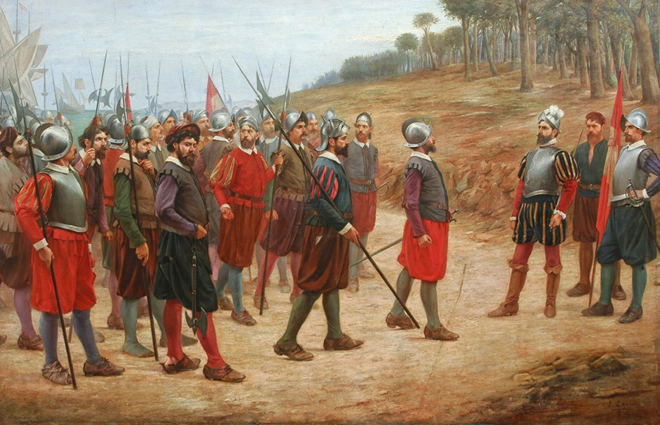
In West Africa, disease confined Europeans to the coasts. In North America, imported illnesses decimated the indigenous population so severely that barely anyone survived. In South America, the situation looked different: the Spanish found a large native population here — and put it to use.
When the Spanish began to appropriate South America, they established the encomienda — a "gift" to the indigenous people. They divided the land into parcels and assigned each one to a Spaniard, the so-called encomendero. The indigenous people were required to pay him tribute and perform labor services. In return, the encomendero would convert them to Christianity.
Mita is a Quechua word for the population's labor obligation to the state — originally applied in agriculture.
In 1545, the Spanish discovered the Potosí silver mines, the largest silver deposit in the Spanish Empire. In 1573, they introduced the mita system of forced labor: the flow of free workers had dried up due to epidemics, and wages had exploded. Despite the costs of guarding workers and transporting them from distances of up to 1,000 kilometers, forced labor once again became profitable for the Spanish.
Potosí, in present-day Bolivia, was at the time one of the largest cities in the world, with around 200,000 inhabitants. The Spanish believed, however, that only people from highland regions could endure the brutal work in mines at 4,000 meters above sea level — and this determined which regions had to supply labor.
The Spanish compelled more than 200 indigenous communities to send every seventh man — roughly 17,500 men in total, or three percent of the indigenous male population. They worked in the silver mines of Potosí and the mercury mines of Huancavelica — mercury being indispensable for silver refining.
One Country, Two Worlds
From that moment on, the fates of Peruvians began to permanently diverge. Local elites were required to deliver forced laborers and ensure their productivity — so they restricted their own population's freedom of movement. Those who sent no men had to pay silver instead, and the Spanish collected these payments without mercy. Most villages therefore sent men.
At the same time, the Spanish prevented the establishment of haciendas — large agricultural estates with their own workforce — within the mita districts. Large landowners there would inevitably have resisted giving up their laborers to the mines. In doing so, the Spanish suppressed competition for workers. Outside the mita districts, however, hacienda owners inadvertently shielded the indigenous people under their control from the long-lasting consequences.
Within the mita districts, large landowners expanded their holdings through cattle theft, grazing their herds on indigenous land, looting, and targeted raids. As a result, no consolidated large-scale landownership developed in the mita districts either.
This stunted the development of public goods: roads connecting producers to larger markets were conspicuously absent — to the detriment of everyone, including small indigenous farms. In the haciendas, by contrast, landowners enjoyed stable property rights — and privileged access to politicians who preferentially channeled infrastructure their way.

The Long Shadow of Colonial Policy
The mita existed for 240 years — the colonial administration only abolished it in 1812, once the silver mines of Potosí were exhausted. Yet the abolition of forced labor did not mean secure property rights for indigenous people for a long time to come.
In 1969, the Peruvian government attempted a land reform: it broke up the large estates and transferred them into collectively managed communes. The experiment failed. The communes collapsed, and the state eventually redistributed the land to individual farmers.
The consequences of the mita remain visible in the statistics to this day. Within the mita boundary, only nine percent of households owned their land before the 1970s — outside it, the figure is 20 percent, and access to education is lower. The road network in mita districts is considerably thinner. Anyone wanting to sell goods there pays far higher transport costs than neighbors just outside the boundary.
Agriculture remains the most important economic sector — around 70 percent of the regional population depends on it. Subsistence farming — growing crops solely for one's own consumption without market access — is far more prevalent than on the other side of the mita boundary. A village inside the boundary consumes roughly 25 percent less today than its neighboring village outside. Children there suffer significantly more frequently from growth disorders.
Despite nearly identical geographic and climatic starting conditions, the mita boundary separates two economic worlds — hundreds of years after it was drawn.
![The aftereffects of the Spanish mita are cartographically visible. Communities within the mita boundary (green line) continue to show significantly higher rates of childhood growth disorders and lower incomes to this day. Two neighboring villages separated only by a colonial forced-labor boundary still differ fundamentally in their prosperity centuries later. (Source: [2])](https://static.wixstatic.com/media/66da30_3317da465309483c9da471d5a8eb3fb3~mv2.png/v1/fill/w_660,h_330,al_c,q_85,enc_avif,quality_auto/66da30_3317da465309483c9da471d5a8eb3fb3~mv2.png)
Why Forced Labor Failed in North America
In West Africa, disease confined Europeans to the coasts. In North America, imported illnesses decimated the indigenous population so severely that barely anyone survived. In South America, the situation looked different: the Spanish found a large native population here — and put it to use.
The Spanish applied similar methods across Latin America: they subjugated the indigenous peoples to plunder the continent's gold and silver wealth.
The English would have liked to do the same — but they arrived too late. The Spanish had already occupied all the wealthy territories. When they founded their first colony at Jamestown in Virginia, they too had no intention of doing hard agricultural labor. Instead, they envisioned the same strategy that had brought the conquistadors Pizarro and Cortés their success: take the chief hostage, force the indigenous people into compulsory labor, and extract the land's riches.
The plan failed, and their supplies ran out. There was no gold to be wrested from the local population — who, moreover, met them with hostility and suspicion.
The real problem, however, was population density. At the time of colonization, it stood at around four hundred people per square mile in South America — in North America, fewer than one. What had worked in Latin America was simply not possible here: the settlers had to work themselves.
So they persuaded the Virginia Company to send capable people — carpenters, farmers, gardeners, fishermen, blacksmiths, masons, and land clearers — a handful of them worth more than a thousand of their own kind: goldsmiths and shortsighted fortune hunters.
From Exploitation to Self-Governance
Not that the Virginia Company didn't try to exploit the settlers and colonists instead of the indigenous people. The colony operated under something close to martial law. The death penalty applied even for the most minor offenses.
The learning curve of the English elites was no less steep than that of the Spanish, until they understood that they had to offer settlers economic and political freedoms — not a servant society of maids and farmhands dreamed up at a drawing board in London.
Anyone who found the conditions intolerable defected to the Indians or struck out independently on the colonial frontier if their needs were not respected. This constrained the power of the Virginia Company more effectively than any law.
By around 1720, all thirteen colonies had introduced similar inclusive institutions — simply because they would not have survived otherwise. From these institutions eventually grew the congresses that declared independence from England and founded the United States of America.

South America Becomes North America's Antipode
In South America, the elites did not even adopt the liberal reforms that Napoleon and the Springtime of Nations of 1848 had triggered in Europe. The great landowners dreaded the prospect. While American independence was a liberation strike against colonial rule, the independence of Mexico and other Latin American countries remained a project of the local elites — the criollos, American-born descendants of European settlers. They enjoyed economic influence but were politically subordinate to the peninsulares sent from Spain.
They had no desire to submit to the liberal reforms and the push for equality unfolding in Europe. South American independence was therefore not a liberation struggle from below, but an elite project to seize economic power — nothing changed in the social hierarchy of suppressed indigenous peoples and enslaved people.
Whether Europeans could settle permanently in large numbers ultimately determined a country's institutional future. Where the disease burden was high or a dense indigenous population already existed, the prospects for inclusive institutions were poor. Extractive institutions and exploitative autocracies became more likely there.

The „Scramble for Africa“
For a long time, disease forced Europeans to remain on Africa's coasts — where they monopolized the trade in slaves, gold, and ivory. Hence names like the Gold Coast, Pepper Coast, Ivory Coast, and Slave Coast.
Europeans invested heavily in order to gain a foothold in the interior as well. From 1850 onward, they became better at managing health risks in tropical climates. Insights stemming from Pasteur and Koch enabled targeted hygiene measures from 1870 onward. The first vaccines came to market.
The antimalarial drug quinine became widely available — in Senegal, the mortality rate of French soldiers fell from 16.3 to under three percent. From 1880 onward, Europe's Scramble for Africa followed — the systematic colonization of the continent.
Here, too, the patterns of preceding centuries repeated themselves.
The Persistence of Institutions
The "operating systems" installed by the Europeans outlasted their colonial empires. In the Neo-Europes, private property and civil liberties remained the foundation. Elsewhere, new elites seized the power of the colonial rulers and continued their dominion seamlessly.
These were mostly the privileged elites to whom the colonial rulers had delegated the day-to-day administration of densely populated regions. They continued their practices: prohibitively high taxes, crushing regulations designed to keep out competition, and forced labor. In some places they even intensified these methods — for instance in the case of export commodities such as cotton or rubber.
The new rulers had just as little interest in more inclusive institutions as the French, English, or Spanish before them. Building such institutions is costly — especially when they constrain one's own power. They would erode the returns from extractive industries.
In such countries, per capita incomes remained low and poverty high. But those in power cared little: they further entrenched their grip instead, and could no more be voted out of office than their colonial predecessors. Conversely, in countries like Australia and New Zealand, politicians triggered investment booms — in the hope of winning votes.
This explains why institutional paths remained so persistent even after decolonization. In Peru, the invisible boundary still runs through the country today. Comparable patterns can be found all over the world. Yet nothing shapes prosperity and poverty as decisively as a country's institutional framework — and emigrants from Europe laid its foundations. [1] [2]
Further Reading
D. Acemoglu, S. Johnson und J. Robinson, „The Colonial Origins of Comparative Development: An Empirical Investigation,“ NBER Working Paper 7771, pp. 1-69, 2000. |
M. Dell, „The Persistent Effects of Peru's Mining Mita,“ Econometrica, Vol. 78, no. 6, pp. 1863-1903, 2010. |
S. Blaschka-Eick, In die Neue Welt! Deutsche Auswanderer in drei Jahrhunderten, Hamburg: Rowohlt Verlag, 2010. |


Comments